XP95 vs XP100, Which Petrol Is Right for Your Vehicle?
-
 Editorial Team
 - 14 Jul, 2026
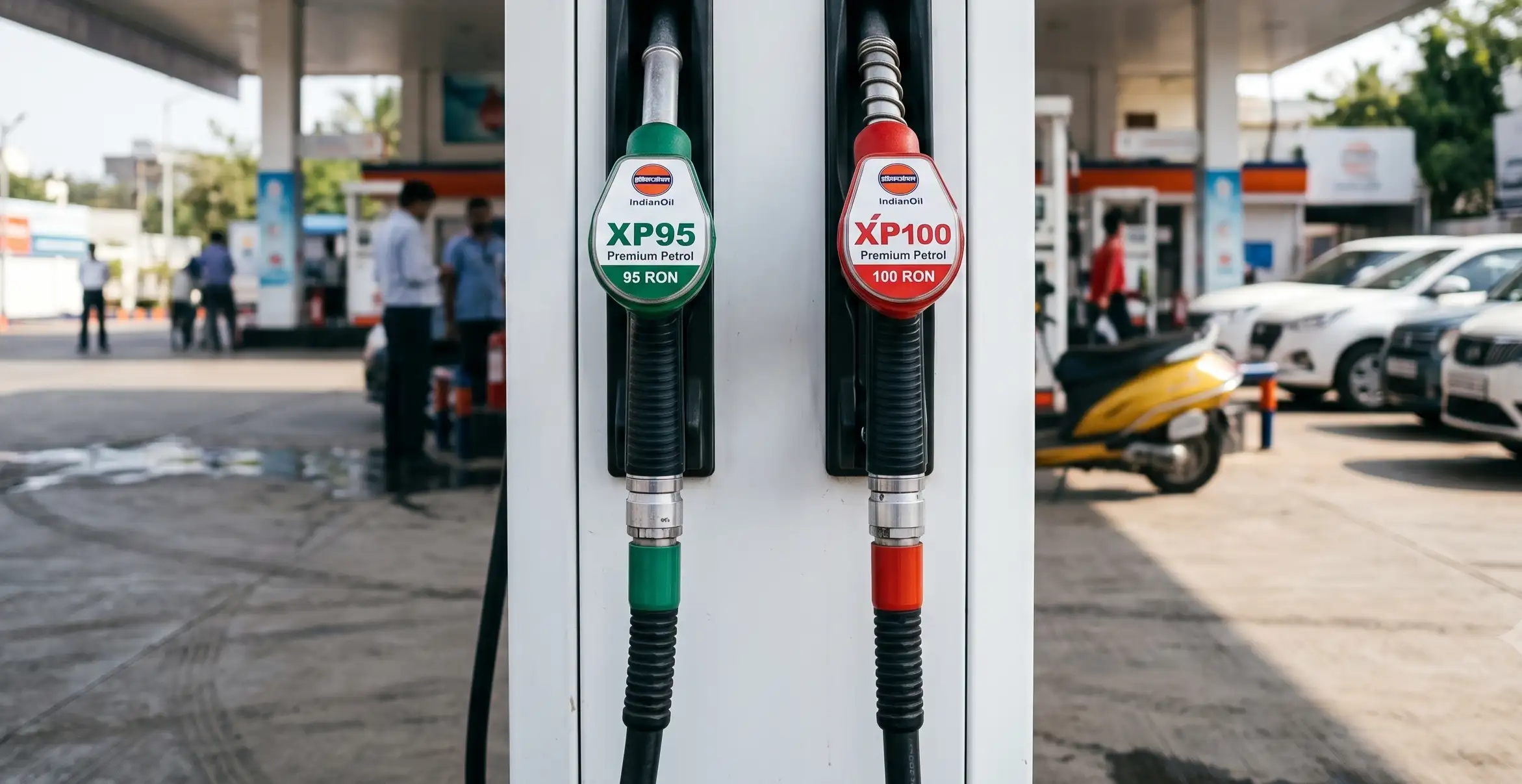
The most common question we see from Indian vehicle owners right now is a variation of this: “I heard XP95 is better than regular petrol. And is XP100 the one without ethanol? Should I be using that instead?”
Both questions are understandable. Both usually get incomplete answers. XP95 and XP100 are sold side by side at IndianOil pumps, both carry the word “premium,” both cost more than regular petrol, and both have been mentioned in the same breath as E20 confusion. But they are chemically different products built on different refining technologies, priced for different markets, and designed for engines that have almost nothing in common.
This article separates the facts from the marketing. By the end, you will know exactly what is in each fuel, which engine types benefit from each, what you are actually paying for, and the one scenario where XP100 matters to riders and drivers who have never considered it before.
Table of Contents
- What XP95 Actually Is, and What It Is Not
- What XP100 Actually Is, the Ethanol-Free Fuel
- How RON Works and Why It Matters for Your Engine
- Which Vehicles Benefit from XP95
- Which Vehicles Benefit from XP100
- The Price Reality, What You Are Actually Paying For
- Where to Find XP100, and Why It Is Hard to Find
- Sources
What XP95 Actually Is, and What It Is Not
XP95 is IndianOil’s standard premium petrol grade. It carries a minimum Research Octane Number of 95 RON and is blended with approximately 20% anhydrous ethanol by volume. It is, in precise chemical terms, an E20 fuel, identical in ethanol concentration to regular petrol at the pump.
This is not a speculation or an inference. An IndianOil RTI response confirmed it. Independent gas chromatography testing of IOCL’s XP95, conducted per the ASTM D4815 standard and reported by Autocar India, found an ethanol content of 19.88% by volume. The regular petrol tested in the same batch showed 20.86%. The ethanol concentration in both fuels is effectively identical.
What XP95 has that regular petrol does not is a proprietary additive package. The additives include advanced friction modifiers, corrosion inhibitors, and detergent compounds that IOCL claims deliver a 3.95% improvement in fuel economy, a 4% increase in power output, and a 20.15% improvement in acceleration compared to unadditised 91 RON fuel. These are IOCL’s own figures from their official XP95 product page. The higher RON is achieved through the ethanol content itself, ethanol has a naturally high octane rating of approximately 108.5 RON, and at a 20% blend concentration it raises the overall anti-knock index of the fuel.
What XP95 is not: it is not ethanol-reduced, it is not a protection fuel for BS4 or older vehicles, and it is not safer than regular petrol for fuel systems that are incompatible with ethanol. XP95 and regular E20 petrol carry the same ethanol load. The difference is in additives and octane, not in ethanol content.
What XP100 Actually Is, the Ethanol-Free Fuel
XP100 is a fundamentally different product. It is India’s only commercially available 100 RON petrol and the only ethanol-free (E0) fuel available at standard retail pumps. Independent testing of IOCL’s XP100 found an ethanol content of less than 0.2% by volume, effectively zero. Instead of ethanol, XP100 uses Methyl Tertiary-Butyl Ether (MTBE) as its primary oxygenate, at approximately 12.38% by volume.
MTBE is a synthetic ether manufactured from methanol and isobutylene. Its pure RON ranges between 115 and 135, which is why even at a 12.38% blend concentration it can elevate the finished fuel to 100 RON. Unlike ethanol, MTBE does not absorb atmospheric moisture. It has low water solubility (approximately 4.2% by weight at saturation), does not form the ethanol-water azeotrope that triggers phase separation, and does not cause the elastomer degradation that makes ethanol problematic in older fuel systems.
The production of XP100 depends on IOCL’s proprietary Octamax technology, a refining process developed entirely by IndianOil’s R&D Centre and commissioned at the Mathura Refinery in January 2018. The Octamax process converts C4 hydrocarbon streams (butanes and butylenes, byproducts of Fluid Catalytic Cracking units) into an ultra-high-octane gasoline blending component with a blending RON above 120. The first samples from the Mathura unit yielded a blending octane of 118, above the guaranteed 108 baseline. IOCL’s R&D team won the National Technology Award in 2022 for this process under the category “Successful Commercialization of Indigenous Technology.”
The practical consequence of MTBE over ethanol for the vehicle owner: XP100 does not degrade in underground storage tanks at low-turnover stations the way ethanol-blended fuel does. It does not corrode nitrile rubber seals. It does not trigger phase separation during monsoon humidity spikes. And it carries more energy per litre than E20 blends, because it does not dilute the hydrocarbon base with the lower-caloric-value ethanol.
How RON Works and Why It Matters for Your Engine
RON, Research Octane Number, measures a fuel’s resistance to auto-ignition under compression. In an internal combustion engine, the air-fuel mixture is compressed before the spark plug fires. A fuel that ignites prematurely from heat and pressure alone, before the spark, creates opposing pressure waves inside the cylinder. This is engine knock, or detonation. Prolonged detonation damages pistons, connecting rods, and valves.
Modern engines, particularly turbocharged ones, are managed by ECUs that listen for knock via acoustic sensors. The moment knock is detected, the ECU retards ignition timing, firing the spark plug later in the compression stroke to prevent the fuel from auto-igniting. Retarded timing protects the engine but sacrifices efficiency: the combustion gases push on the piston at a less optimal angle, delivering less energy to the crankshaft. The engine produces less power and consumes more fuel to compensate.
This is why RON matters. A higher-RON fuel gives the ECU more headroom before knock occurs. The ECU can maintain, or even advance, ignition timing, extracting more work from each combustion cycle. For engines specifically calibrated to use this headroom (high-compression, turbocharged engines with aggressive ECU maps), the difference between 91 RON, 95 RON, and 100 RON is a tangible performance and efficiency variable. For engines that are not calibrated to use the headroom, naturally aspirated, low-compression engines in commuter bikes and entry-level cars, using a higher RON fuel provides no measurable benefit. The ECU simply does not advance timing further than its calibrated limit, regardless of how much knock resistance the fuel offers.
Standard petrol in India moved from 91 RON to a minimum of 95 RON with the E20 mandate from April 2026. Every fuel at the pump, including regular petrol, is now at least 95 RON. XP95 is 95 RON. XP100 is 100 RON.
Which Vehicles Benefit from XP95
XP95 is the right fuel for the majority of modern Indian vehicles, with one important clarification. It delivers measurable value specifically to turbocharged petrol engines manufactured after April 2020 (BS6 Phase 1 and Phase 2). These engines have ECUs calibrated to use 95 RON fuel and will advance ignition timing optimally. The additives in XP95 provide genuine injector cleaning benefit for GDI engines, which accumulate carbon deposits faster than port-injection engines because fuel does not wash the intake valves.
Team-BHP long-term testing of XP95 in a Skoda Slavia 1.5L DSG showed average urban fuel returns of 7.5 to 8.5 km/l, a measurable improvement over equivalent figures on standard 91 RON fuel in pre-E20 testing. Users of the Hyundai Creta 1.4 T-GDI, Tata Nexon 1.2 Turbo, and VW Taigun 1.0 TSI report similar patterns: smoother idle, reduced vibration under hard acceleration, and slightly better highway mileage compared to standard petrol.
For motorcycles, XP95 is appropriate for BS6 Phase 2 bikes and high-compression single-cylinder performance bikes (KTM Duke 390, Bajaj Dominar 400, Royal Enfield 650 Twins, Suzuki Gixxer SF 250). These engines have ECUs that can use 95 RON effectively. XP95’s detergent package also helps slow injector fouling on performance bikes that see high-RPM use.
What XP95 does not do: it does not protect older fuel system components from ethanol degradation. A BS4 bike or a pre-2023 car running on XP95 is running on 20% ethanol, the same as regular petrol. The additive package does not neutralise ethanol’s solvent effect on nitrile rubber, nor does it prevent phase separation. If your motivation for switching to XP95 is to reduce ethanol exposure, XP95 does not solve that problem.
Which Vehicles Benefit from XP100
XP100’s legitimate use cases are narrower and more specific than its pricing suggests.
The first and most commercially significant case is high-compression performance vehicles. Cars like the Porsche 718 Cayman, BMW M-series, Audi RS models, and Volkswagen’s EA888 Evo4-equipped models (Skoda Kodiaq, Octavia RS) frequently specify a minimum of 98 RON in the owner manual. Running these on E20 95 RON fuel forces the ECU into a double penalty: timing retardation from insufficient knock resistance, plus lower energy density from the ethanol content. XP100’s 100 RON removes the first penalty and its E0 composition removes the second. Team-BHP testing in a Skoda Kodiaq reported efficiency figures jumping from 8.5 km/l on XP95 to over 10.2 km/l, and up to 13.9 km/l in light traffic, on XP100. These gains reflect the ECU recovering thermal energy that was previously being wasted through retarded timing.
The second case is vintage and classic motorcycles and cars. Vehicles manufactured before approximately 2000, Royal Enfield Bullets of the iron-barrel era, Yezdi, Rajdoot, classic Ambassadors, imported classics, have fuel system components that predate any ethanol compatibility requirement. Nitrile rubber seals, untreated steel fuel tanks with original coatings, carburettor float bowls with zinc or magnesium alloys, and brass jets are all vulnerable to continuous E20 exposure. XP100 is the only commercially available pump fuel that provides E0 operation. For owners of these vehicles who cannot access E0 petrol through any other legitimate retail channel, XP100 is not a luxury, it is a preservation tool.
The third case is long-term vehicle storage. Phase separation is the specific risk when a vehicle sits with an E20 tank for weeks or months. Ethanol absorbs moisture from the headspace, the concentration crosses the phase separation threshold, and a water-ethanol layer accumulates at the tank bottom. On recommissioning, this layer enters the fuel system with predictable damage. Filling a tank with XP100 before extended storage eliminates this risk because MTBE does not absorb atmospheric moisture the way ethanol does.
One pattern documented in automotive forums is the “3:1 method”: three refuels on regular E20 or XP95, one on XP100. This seeks to periodically flush accumulated ethanol residue from injectors and dilute the overall ethanol concentration across the fuel system without bearing the full cost of XP100 for every tank. It is not an OEM recommendation, but the chemistry of periodic flushing has a rational basis.
What XP100 does not do: it provides no measurable benefit to naturally aspirated low-compression engines in commuter bikes (Hero Splendor, Honda Activa, Bajaj Pulsar 150) or standard sedans (Maruti Swift K12N, Hyundai Grand i10 1.2). These engines cannot advance timing further than their ECU’s calibration ceiling, regardless of RON. Filling a Splendor with XP100 at Rs 160 per litre accomplishes nothing that regular petrol at Rs 105 does not, except drain your wallet.
The Price Reality, What You Are Actually Paying For
Fuel pricing in Pune in mid-2026 illustrates the economic gap clearly. Standard 91 RON petrol trades between Rs 103.82 and Rs 112.04 per litre. XP95 carries a Rs 3 to Rs 5 premium over standard petrol, placing it at approximately Rs 111.85 to Rs 115.66 per litre. XP100, unprotected by government price controls and burdened by Octamax process costs and imported MTBE, rose to Rs 160 to Rs 167.35 per litre following an Rs 11 single-day price hike triggered by global crude market volatility in early 2026. Check petrolprice.in for your city’s current prices, these figures change with global crude and state VAT.
For XP95, the cost-benefit is straightforward for turbocharged engines. The Rs 3 to Rs 5 premium per litre is partially or fully offset by the documented 3% to 4% mileage improvement in calibrated engines, and the long-term injector cleaning benefit reduces service costs. For naturally aspirated commuter engines, the premium buys nothing performance-related, though the additive package still provides some cleaning value.
For XP100, the premium is 50% to 60% above standard petrol. For a high-performance car requiring 98+ RON, the calculation includes not just pump price but the mileage penalty of running the wrong fuel, an engine retarding timing and burning more E20 fuel may cost more per kilometre than XP100 at optimised timing. For a commuter bike or standard sedan, there is no legitimate cost justification. For a vintage vehicle owner using XP100 as a preservation measure, the cost is weighed against the cost of replacing corroded fuel system components, and corrosion typically costs more.
One alternative that some enthusiasts attempt is aftermarket octane boosters, chemicals like Ferrocene, NMA (N-Methyl Aniline), or MMT added to XP95 to reach 100 RON equivalent. These do elevate the octane number but introduce metallic ash deposits on spark plugs, oxygen sensors, and catalytic converters. These deposits eventually trigger check-engine lights and require expensive sensor or catalyst replacement. Refinery-blended XP100 using ashless MTBE remains the only genuinely safe route to ultra-high octane at the pump.
Where to Find XP100, and Why It Is Hard to Find
XP100 is distributed exclusively through Company-Owned and Company-Operated (COCO) retail outlets, stations operated directly by IOCL rather than franchise dealers. This vertical integration allows IOCL to maintain quality control over a niche, high-value product and prevent adulteration. The trade-off is availability. In a country with over 100,000 fuel stations, XP100 is stocked at only a few hundred vetted locations.
The practical implication is that finding XP100 requires planning. The most reliable official source is the Indian Oil One mobile application, which has a filter for XP100-stocked stations. In Pune, locations that the automotive community has mapped as consistent XP100 suppliers include Sure Petroleum in Erandwane and Sukhwani Petroleum in Wakad. Similar community-verified station lists exist on Reddit’s r/pune and r/CarsIndia threads for other cities.
Because XP100 is a low-turnover product at most stations, freshness is a genuine concern, not because MTBE degrades like ethanol does, but because any fuel sitting in a storage tank for months in adverse conditions can pick up trace contamination from the tank itself. Sticking to COCO pumps, which IOCL manages directly and which see higher accountability than franchise locations, is the practical mitigation.
The Ethanol Fuel Finder on this site maps verified XP100 and HPCL Power 100 stations across India. HPCL’s Power 100 is the direct equivalent of XP100 from a different OMC, 100 RON, E0, MTBE-based. BPCL’s Speed 100 occupies the same category. If XP100 is unavailable near you, Power 100 or Speed 100 at an HPCL or BPCL COCO outlet is chemically equivalent.
Sources
- IOCL XP95, Official Product Page, IndianOil
- IOCL XP100 and Motorists Page, IndianOil
- How Much Ethanol Is in Your Petrol? Gas Chromatography Testing, Autocar India
- Even Premium XP95 Petrol Has 20% Ethanol, IOCL RTI Response, Cartoq
- Octamax Technology, IOCL R&D Leaflet, Mathura Refinery Commissioning
- IndianOil Commissions Octamax Unit at Mathura, Europétrole
- Experiencing 100 RON Fuel in My Skoda Kodiaq, Team-BHP
- Tried XP100 Petrol on My Slavia 1.5L DSG, Team-BHP
- High-Octane Petrol Prices Hiked, JM Financial Services, March 2026
- E20 Petrol Row, What Is XP100, Is It Really Ethanol-Free?, LiveMint