Showing Posts From
Flex fuel
-
 Ajit Khandekar
 - 08 Jul, 2026
E85 Petrol in India - Where Is It Available and Who Can Use It?
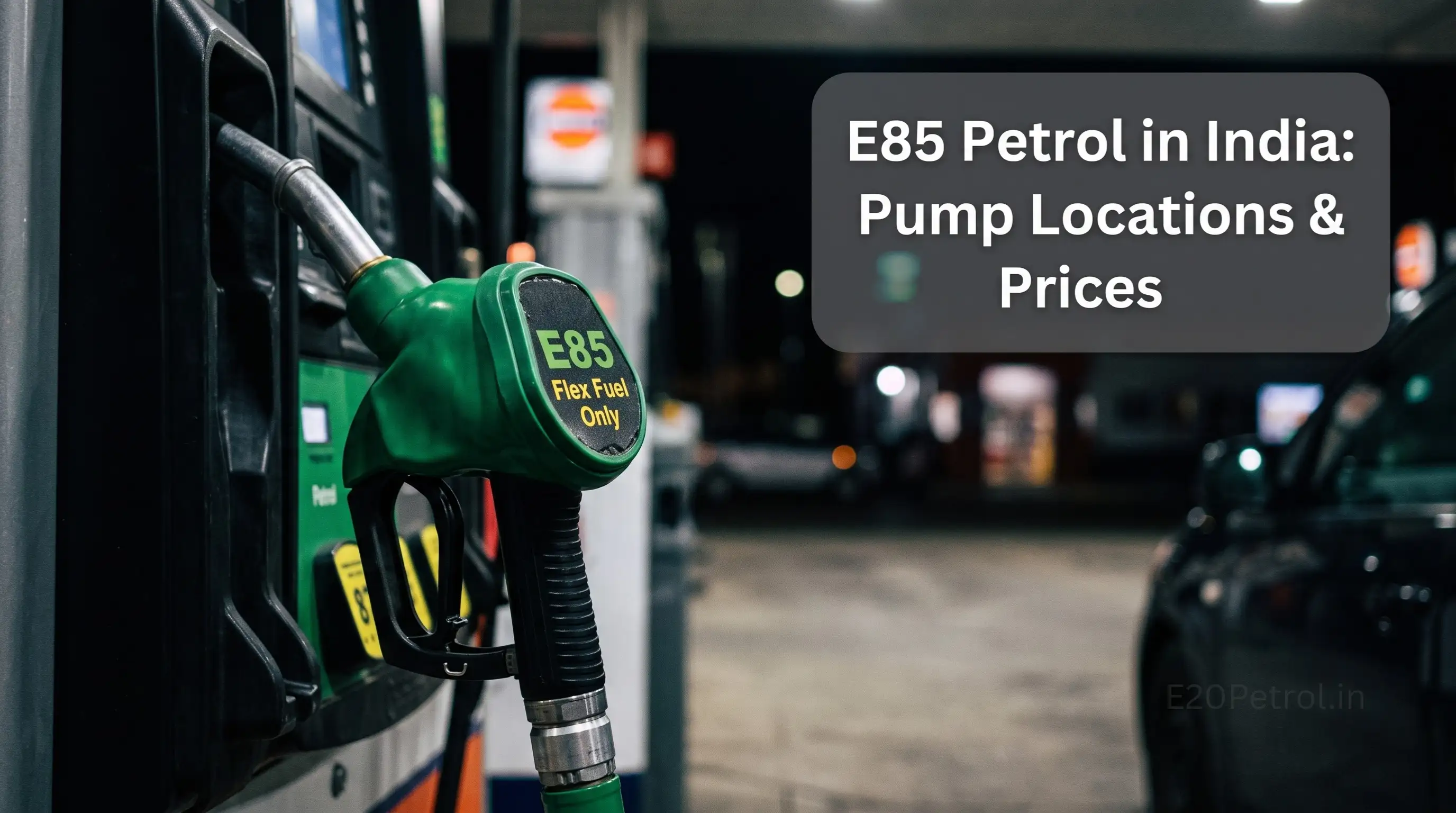
India's flex fuel era began commercially on 5 June 2026. On World Environment Day, Union Minister for Petroleum and Natural Gas Shri Hardeep Singh Puri inaugurated the country's first commercial E85 dispensing station at an IndianOil outlet on Pusa Road, New Delhi. The launch marked the transition from pilot programs to a structured national rollout. E85 is now available at 48 retail outlets across India as of this writing. That number is projected to reach 500 by December 2026 and 5,000 by December 2027. Two flex fuel motorcycles are already on sale. Two flex fuel cars are launched. More are confirmed. But E85 is not for every vehicle, and using it in a standard petrol car or bike can cause severe and immediate engine damage. This article covers where E85 is available, how it is priced, what it costs to run per kilometre, which vehicles are officially compatible, and why using it in a non-FFV is a straightforward mechanical risk, not a grey area. This page is updated as new station data is confirmed. Last updated: July 2026. Table of ContentsThe Launch - What Happened on 5 June 2026 Where E85 Is Available in India Right Now E85 Price Across Cities - and the Real Cost per Kilometre What E85 Actually Is - Composition and BIS Standard Which Vehicles Can Officially Use E85 in India What Happens If You Use E85 in a Standard Petrol Vehicle The Expansion Roadmap - 500 Stations by December 2026 SourcesThe Launch - What Happened on 5 June 2026 The commercial launch of E85 in India was timed to align with World Environment Day, a deliberate signal of the government's framing of the ethanol programme as an environmental initiative. The first dispensing station was commissioned at IndianOil's Pusa Road outlet in New Delhi, chosen for its visibility in the national capital and proximity to government ministry traffic. The initial rollout covered 48 operational retail outlets managed collectively by three public sector oil marketing companies: IndianOil (IOCL), Bharat Petroleum (BPCL), and Hindustan Petroleum (HPCL). These 48 stations represent the commercial proof-of-concept phase, a retail network designed to establish that the supply chain, quality control, and consumer demand can function before wider deployment. The geographic focus of Phase 1 was urban and highway-centric: Delhi-NCR, Mumbai, Pune, Nagpur, and Bengaluru. This selection reflects both air quality priorities (these are among the most polluted urban centres in India) and proximity to the ethanol supply chain from sugarcane-producing states. The government confirmed at launch that E85 fuel launch "does not make existing petrol vehicles obsolete," directly addressing public concern that standard petrol might be phased out. Where E85 Is Available in India Right Now As of July 2026, E85 is available at 48 stations across India's major urban centres. The distribution is concentrated in Delhi-NCR, with stations across multiple IOCL, BPCL, and HPCL outlets in the capital region. Mumbai received its first E85 pump shortly after the national launch, with Autocar India and BikeWale reporting the Mumbai price point in June 2026. Pune, Nagpur, and Bengaluru are part of the initial network. The station count by city is not comprehensively published in a single government source as of this writing. The most reliable way to locate the nearest E85 station is to use the IndianOil, BPCL, or HPCL dealer locator applications and filter by fuel type. The E0 Fuel Finder on this site covers ethanol-free XP100 and Power 100 stations, not E85. We are working on adding E85 station data as the network expands. It is important to verify the E85 status of a specific outlet before travelling to it. E85 dispensers are physically separate from standard E20 pumps, and not every pump at an E85-equipped station will have the E85 nozzle. Look specifically for the "E85" label on the dispenser. E85 Price Across Cities - and the Real Cost per Kilometre E85 is priced at a deliberate discount to E20 across India, with variation driven by state VAT and transport costs. The pricing as reported at launch is as follows. In New Delhi, E85 is priced at Rs 82.12 per litre, exactly Rs 20 cheaper than E20 petrol at Rs 102.12 per litre in the city. In Mumbai, E85 retails at Rs 91.18 per litre, which is Rs 20.03 cheaper than Mumbai's E20 petrol price of Rs 111.21 per litre. Mumbai E85 is approximately Rs 9 per litre more expensive than Delhi E85 due to higher state VAT. The pump price difference does not directly translate to lower running costs. E85 contains approximately 30% to 35% less energy per litre than petrol. Flex fuel vehicles running on E85 experience a fuel efficiency penalty of 25% to 35% compared to running on E20. The cost-per-kilometre calculation depends on the specific vehicle and its E85 calibration. As a reference, a Hero Splendor+ Flex Fuel achieving 55 kmpl on E20 may return approximately 38 to 42 kmpl on E85. At those figures, the cost per kilometre on E20 in Delhi works out to approximately Rs 1.86 per km (Rs 102.12 per litre divided by 55 kmpl). On E85 at 40 kmpl, it is Rs 2.05 per km (Rs 82.12 per litre divided by 40 kmpl). At current prices, E85 costs slightly more per kilometre to run despite the cheaper pump price, but the margin is narrow, and any price increase in E20 or price decrease in E85 shifts the calculation. For petrol price verification in your state, check petrolprice.in, which publishes daily state-wise fuel prices. The formula to calculate E85 cost-per-kilometre is: E85 pump price divided by your vehicle's E85 mileage in kmpl. What E85 Actually Is - Composition and BIS Standard E85 is not a fixed composition fuel, it is a regulated range. Under BIS standard IS 16634:2017, which governs high-blend ethanol fuels in the 70% to 85% ethanol range, E85 is defined as containing 80% to 85% anhydrous ethanol mixed with 14% to 19% conventional motor gasoline. The "anhydrous" specification is critical: any significant water content in the ethanol supply chain would trigger phase separation in distribution tanks and vehicle fuel systems, causing immediate mechanical damage. E85 has a Research Octane Number of approximately 108. This is significantly higher than E20's 95 RON minimum, which explains why dedicated FFV engines can run at higher compression ratios and more aggressive ignition advance when on E85, extracting more efficiency per combustion cycle to partially offset the lower energy density. E85 is distinct from E30 and intermediate blends. BIS IS 19850:2026, notified on 15 May 2026, covers E22, E25, E27, and E30 intermediate blends. These are governed under a separate standard and are not yet at retail pumps. The pathway from E20 to E85 in India's fuel roadmap is not a linear retail progression, E20 is the current standard, E85 is a parallel premium option for FFVs, and E30 is a future intermediate step that remains in the infrastructure planning stage. Which Vehicles Can Officially Use E85 in India Only vehicles that are type-approved under AIS-171 and carry MoRTH flex fuel certification should use E85. The officially confirmed FFV vehicles available in India as of July 2026 are as follows. In the motorcycle segment: the Hero Splendor+ Flex Fuel, available from July 2026, certified for E20 to E85; the Hero HF Deluxe Flex Fuel, available from July 2026, certified for E20 to E85; and the Suzuki Gixxer SF 250 Flex Fuel, launched at Auto Expo 2025, certified for E20 to E85. In the passenger car segment: the Maruti Wagon R Flex Fuel, launched at Rs 7.24 lakh, certified for E20 to E85. Upcoming FFV vehicles with confirmed production timelines include the Maruti Fronx Flex Fuel, the Tata Punch Flex Fuel, and the Mahindra XUV 3XO FFV, all expected through 2026 to 2027. These vehicles are not yet on sale and should not be assumed to be available until launch confirmations are published. If your vehicle is not on this list (including BS6 Phase 2 vehicles certified for E20) it is not certified for E85. What Happens If You Use E85 in a Standard Petrol Vehicle Using E85 in a non-FFV causes immediate and specific mechanical failure. The failure modes are not gradual degradation, they are acute, because a standard petrol engine calibrated for E20 cannot compensate for the dramatically different stoichiometry of E85. The first failure mode is severe lean running. A standard petrol injector sized for E20 cannot deliver enough fuel volume to match E85's stoichiometric requirement. The engine runs severely lean, too little fuel relative to air. Lean combustion at high temperatures causes detonation (engine knock), rapid cylinder head heating, and can damage pistons, valves, and the combustion chamber within a single tank if driven at sustained load. The second is material degradation. Standard E20-compatible fuel system seals, hoses, and pump materials are not rated for continuous E85 exposure. Immediate seal swelling and cracking, injector O-ring failure, and fuel pump damage are documented outcomes in international cases of E85 misfuelling. The government's own communication confirmed at the E85 launch that the fuel "does not make existing petrol vehicles obsolete", meaning standard petrol vehicles continue to use E20. This is not an endorsement of casual experimentation with E85 in non-FFV vehicles. No OEM warranty covers E85-induced damage in a non-certified vehicle. No insurer is obligated to cover it. The Expansion Roadmap - 500 Stations by December 2026 MoPNG has established a two-stage expansion target. The short-term target is 500 E85 retail outlets by December 2026, scaling from the initial 48 stations. The medium-term target is 5,000 stations by December 2027, establishing a pan-India retail presence across major cities and interstate corridors. The strategic objective behind these targets is to create sufficient retail density to justify mass-market FFV vehicle production. OEMs have cited infrastructure certainty as a prerequisite for scaling FFV product lines. The confirmed FFV launches from Hero, Maruti, Tata, and Mahindra suggest OEMs believe the infrastructure trajectory is credible. The supply-side risk is 2G ethanol. Current E85 supply relies primarily on 1G ethanol derived from sugarcane. Industry analysts have noted that scaling to 5,000 stations will require either a significant expansion of 1G ethanol supply (which competes with food production) or the commercial viability of 2G ethanol from agricultural waste, which is in pilot stages. The supply constraint is not acknowledged in MoPNG's public expansion targets but is a material risk to the timeline. This page will be updated when new station counts are officially confirmed. SourcesE85 Commercial Launch - IndianOil, Pusa Road New Delhi, 5 June 2026 - PIB E85 Now Available in Mumbai at Rs 91.18 Per Litre - Autocar India E85 Fuel Priced at Rs 91.18 Per Litre in Mumbai - Team-BHP BIS IS 16634:2017 - High-Blend Ethanol Fuel Standard - Indian Standards on Biofuel, PIB BIS IS 19850:2026 - Standards for E22-E30 Blends - Government Notification, CA Sansaar Hero MotoCorp Flex Fuel Launch Press Release, June 2026 Maruti Suzuki WagonR Flex Fuel Launched at Rs 7.24 Lakh - CarDekho E85 Fuel Launch Does Not Make Existing Petrol Vehicles Obsolete - Chini Mandi India's E85 Launch - Without 2G Ethanol, Supply Side Won't Catch Up - Khaitan Bioenergy How E20 Affects Your Car and What's Next on E85 Rollout - Times of India
- Ajit Khandekar
- 02 Jul, 2026
What Is a Flex Fuel Vehicle? India's FFV Explained Simply
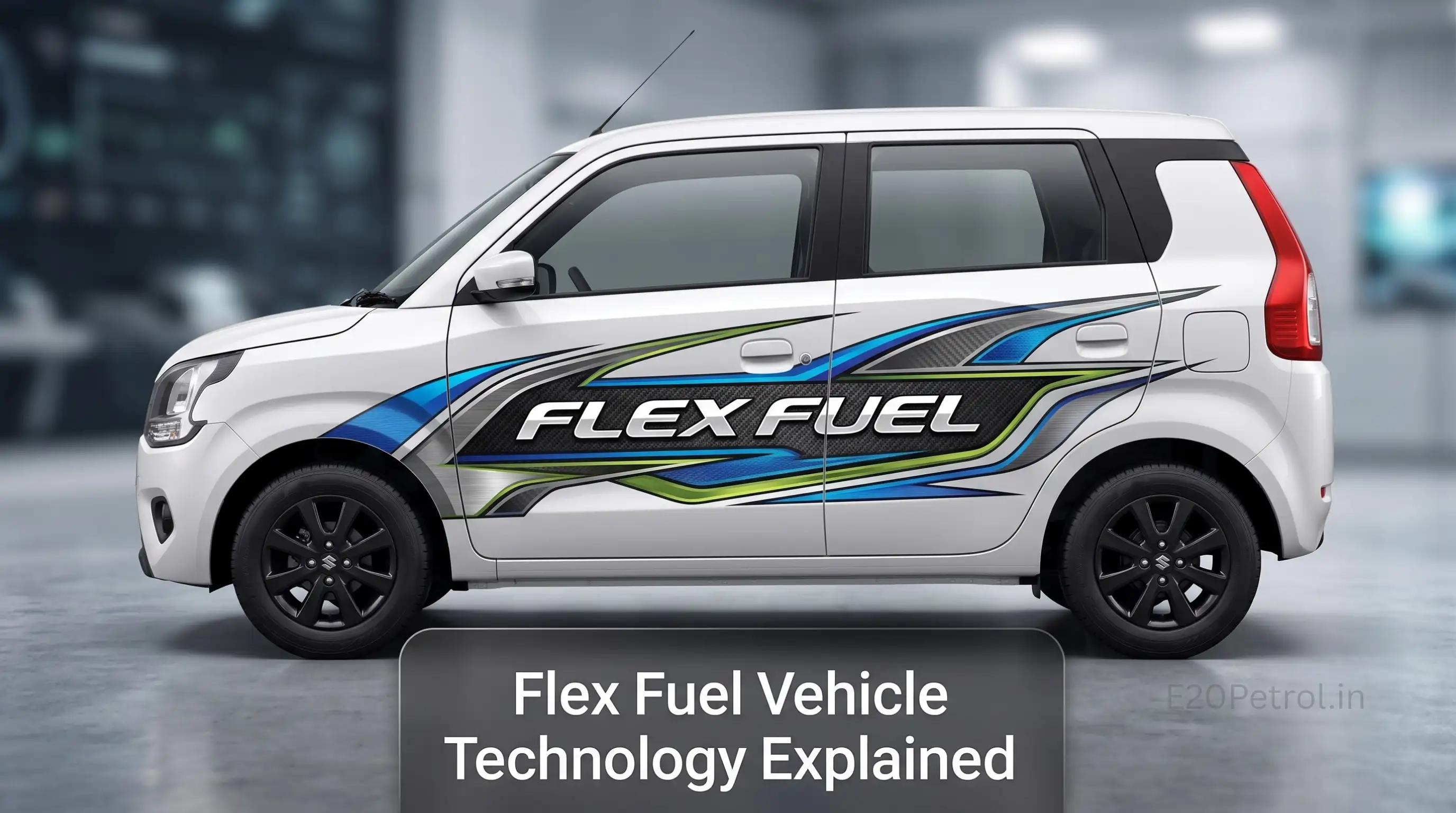
India completed its E20 mandate on 1 April 2026. Five years earlier than the original schedule, every petrol pump in the country now dispenses ethanol-blended fuel as the only standard grade. The next stage in the same ethanol roadmap is already underway: E85 went on commercial sale at 48 retail outlets from 5 June 2026, and two production flex fuel motorcycles (the Hero Splendor+ Flex Fuel and the Hero HF Deluxe Flex Fuel) are available for private buyers from July 2026. These are not concept vehicles. They are the first consumer products in India designed to run on any blend from E20 to E85, and they mark a structural shift in what is possible at an Indian fuel pump. But the term "flex fuel vehicle" is used loosely, and the mechanics of what makes a vehicle genuinely flex-fuel capable are not widely understood. This article explains what an FFV actually is, how it differs from a standard petrol vehicle, what the Indian regulatory framework requires, and what the current vehicle landscape looks like. Table of ContentsThe Official Indian Definition of a Flex Fuel Vehicle How an FFV Engine Differs from a Standard Petrol Engine The BIS Standards Framework - IS 16634 and IS 19850:2026 What Fuel Blends an FFV Can Use - and at What Cost FFVs Now Available in India Why Brazil Matters - The Only Country That Has Done This at Scale SourcesThe Official Indian Definition of a Flex Fuel Vehicle In India's regulatory framework, a Flex Fuel Vehicle is officially defined as a vehicle equipped with an internal combustion engine designed to run on more than one type of fuel, or on any mixture of those fuels, typically any blend of petrol and anhydrous ethanol ranging from E20 up to E85 or E100. The legal foundation for FFVs was established under the Central Motor Vehicles Rules (CMVR), 1989. MoRTH issued the foundational safety guidelines through gazette notification G.S.R. 343(E) dated 25 May 2021. This notification is backed by the Automotive Industry Standard AIS-171, titled "Safety Requirements for Type Approval of Anhydrous Ethanol and Ethanol Blended Motor Gasoline (EBMG) Vehicles." AIS-171 was formulated on behalf of MoRTH and published by ARAI. It establishes the safety, material compatibility, electrical conductivity, and emission testing protocols for all vehicles operating on ethanol-gasoline blends of 20% and above. The distinction between an FFV and a standard E20-compliant vehicle is important to state precisely. A BS6 Phase 2 motorcycle manufactured after April 2023 is E20-compliant, it can handle 20% ethanol without material degradation. It is not an FFV. An FFV can handle any blend from E20 to E85, or E20 to E100 in some configurations, because it has additional engineering specifically designed for variable fuel composition. The two terms are not interchangeable. How an FFV Engine Differs from a Standard Petrol Engine A standard petrol engine is calibrated for a specific fuel composition. Its injector sizing, fuel delivery pressure, ignition timing, and ECU calibration maps are set to optimise for that composition. When the fuel composition changes (say, from E10 to E20) the engine's closed-loop feedback makes partial adjustments but cannot fully optimise because its calibration range is limited. An FFV engine is designed for a range of fuel compositions. The changes required to support this range are interconnected and cannot be done piecemeal. The first is a fuel composition sensor, commonly called a flex fuel sensor or ethanol content sensor. This sensor sits in the fuel line between the tank and the injectors and measures the ethanol concentration in the incoming fuel in real time. The ECU uses this reading to continuously adjust injection duration, fuel rail pressure, and ignition timing across the full range from E20 to E85 or E100. Without this sensor, an engine cannot identify what blend it is running on and cannot calibrate dynamically. The second is injector sizing. Ethanol has approximately 30% to 35% less energy per unit volume than petrol. To deliver the same power output on E85 as on E20, the engine needs to inject a larger volume of fuel. FFV injectors are sized 30% to 40% larger than equivalent petrol injectors to accommodate this. A standard petrol injector running on E85 would starve the engine of fuel at higher load because it cannot flow enough volume. The third is fuel system materials. All seals, hoses, O-rings, fuel pump internals, and tank coatings must be chemically compatible with anhydrous ethanol at concentrations up to 85% or 100%. Materials that pass E20 testing may fail under continuous E85 exposure. FFVs use Viton FKM seals throughout the fuel system, stainless steel fuel rails, and corrosion-resistant fuel pump assemblies. The fourth is ECU calibration maps. An FFV ECU contains multiple calibration tables, effectively a petrol calibration, an E85 calibration, and a continuous interpolation function that blends between them based on the flex fuel sensor reading. The ECU also accounts for the fact that ethanol's higher octane rating (100 to 105+ RON for E85) allows more aggressive ignition advance at high loads without knock. The BIS Standards Framework - IS 16634 and IS 19850:2026 Two BIS standards govern different parts of the ethanol fuel landscape. Understanding which standard applies to which fuel is important. BIS IS 16634:2017 governs E85 and other high-blend ethanol fuels in the 70% to 85% ethanol range. This is the standard that applies to E85 as it currently exists at retail pumps. It specifies physical and chemical parameters including ethanol concentration limits, water content, sulphur limits, and vapour pressure requirements. E85 under IS 16634 contains 80% to 85% anhydrous ethanol by volume, with the "anhydrous" specification critical to prevent phase separation in the distribution network. BIS IS 19850:2026 is a newer standard, notified on 15 May 2026, which establishes technical specifications for intermediate blends, specifically E22, E25, E27, and E30. This standard does not cover E85. It is significant as a forward signal: E30 standards now exist on paper, even though E30 is not yet available at retail pumps. When E30 does arrive, IS 19850:2026 is the document that will govern its fuel quality parameters. E20, the current mandatory fuel, remains governed by the established BIS standard for motor gasoline, IS 2796:2017 with its subsequent amendments, which set the 95 RON floor and 4.2% maximum oxygen content by mass. What Fuel Blends an FFV Can Use - and at What Cost The practical benefit of an FFV is fuel blend flexibility. A Hero Splendor+ Flex Fuel owner can refuel with standard E20 petrol today, switch to E85 at an E85-equipped pump, or use any blend in between, and the vehicle will calibrate automatically. The mileage trade-off is real and should not be obscured. E85 contains approximately 30% to 35% less energy per unit volume than standard petrol. An FFV running on E85 will use a higher volume of fuel to cover the same distance compared to E20. In real-world testing of comparable FFV models, efficiency drops of 25% to 35% on E85 relative to E20 are documented. However, E85 is currently priced approximately Rs 20 per litre cheaper than E20 in Delhi, at Rs 82.12 per litre versus Rs 102.12 per litre. The cost-per-kilometre calculation depends on both the price gap and the efficiency penalty, and the breakeven point varies by vehicle and engine tune. The energy-adjusted cost comparison is what matters. If an FFV covering 100 km uses 3.5 litres on E20 at Rs 102 per litre, that is Rs 357. The same distance on E85 may require 4.5 litres at Rs 82 per litre, totalling Rs 369, marginally more expensive despite the lower pump price. As the E85 station network expands and supply competition increases, the pump price discount may widen enough to shift this calculation. E100, the ultimate flex fuel blend, is theoretically possible with appropriate engine calibration. Its commercial availability in India is a long-horizon prospect, current infrastructure and supply chain planning centres on E85 as the near-term high-blend target. FFVs Now Available in India The Hero Splendor+ Flex Fuel is India's first commercially available flex fuel motorcycle for the mass market. Launched on 3 June 2026 with deliveries beginning July 2026, it is officially rated to run on E20 to E85. Hero MotoCorp's press release confirms AIS-171 compliance and flex fuel sensor fitment. The HF Deluxe Flex Fuel, launched simultaneously at Rs 72,792, targets the high-volume entry commuter segment. The Suzuki Gixxer SF 250 Flex Fuel was launched at Auto Expo 2025 at Rs 2.17 lakh, extending the FFV category to the 250cc performance segment. It is AIS-171 compliant and certified for E20 to E85 operation. The Maruti Wagon R Flex Fuel was launched at Rs 7.24 lakh, Rs 86,000 more than the standard Wagon R petrol variant. It represents the first mass-market flex fuel passenger car in India and is positioned to benefit from the E85 station expansion roadmap. Upcoming FFV cars with confirmed timelines include the Maruti Fronx Flex Fuel, Tata Punch Flex Fuel, and Mahindra XUV 3XO FFV through the 2026 to 2027 period. Why Brazil Matters - The Only Country That Has Done This at Scale Brazil is the only country that has operated a nationwide flex fuel vehicle ecosystem at scale, and its trajectory is the closest operational precedent India has. The Brazilian Automobile Manufacturers Association, ANFAVEA, documented that Brazil introduced commercial flex fuel vehicles in 2003 and reached a point where over 90% of new petrol cars sold in the country were flex fuel capable within a decade. This adoption was driven by a combination of commercially priced ethanol derived from sugarcane and a retail infrastructure that made E85 and E100 genuinely available. India's starting point is different, sugarcane-derived 1G ethanol at scale, 48 E85 stations versus Brazil's mature 45,000-station network, and a far larger legacy fleet of non-FFV vehicles. But the Brazilian precedent confirms that nationwide FFV adoption is technically and commercially achievable when retail fuel infrastructure and vehicle availability move in parallel. The government's target of 5,000 E85 stations by December 2027 is the infrastructure signal that OEMs have cited as justification for their FFV launch commitments. SourcesMoRTH Gazette Notification G.S.R. 343(E), May 2021 - FFV Safety Guidelines AIS-171 - Safety Requirements for Type Approval of EBMG Vehicles, ARAI BIS IS 19850:2026 - Standards for E22, E25, E27, E30 - Vision IAS Current Affairs Hero MotoCorp Press Release - Flex Fuel Motorcycles Launch, June 2026 Hero Splendor+ and HF Deluxe Flex Fuel Deliveries from July 2026 - India Today Maruti Suzuki WagonR Flex Fuel Launched at Rs 7.24 Lakh - V3Cars Suzuki Gixxer SF 250 Flex Fuel Launched at Rs 2.17 Lakh - Autocar India ANFAVEA - History and Technical Information, Brazilian Automobile Manufacturers Association PIB - Ethanol Blending in India, Press Release PRID 2281287 The Flex Fuel Dilemma: All You Need to Know - BikeWale