What Is a Flex Fuel Vehicle? India's FFV Explained Simply
-
 Ajit Khandekar
 - 02 Jul, 2026
India completed its E20 mandate on 1 April 2026. Five years earlier than the original schedule, every petrol pump in the country now dispenses ethanol-blended fuel as the only standard grade. The next stage in the same ethanol roadmap is already underway: E85 went on commercial sale at 48 retail outlets from 5 June 2026, and two production flex fuel motorcycles (the Hero Splendor+ Flex Fuel and the Hero HF Deluxe Flex Fuel) are available for private buyers from July 2026.
These are not concept vehicles. They are the first consumer products in India designed to run on any blend from E20 to E85, and they mark a structural shift in what is possible at an Indian fuel pump. But the term “flex fuel vehicle” is used loosely, and the mechanics of what makes a vehicle genuinely flex-fuel capable are not widely understood.
This article explains what an FFV actually is, how it differs from a standard petrol vehicle, what the Indian regulatory framework requires, and what the current vehicle landscape looks like.
Table of Contents
- The Official Indian Definition of a Flex Fuel Vehicle
- How an FFV Engine Differs from a Standard Petrol Engine
- The BIS Standards Framework - IS 16634 and IS 19850:2026
- What Fuel Blends an FFV Can Use - and at What Cost
- FFVs Now Available in India
- Why Brazil Matters - The Only Country That Has Done This at Scale
- Sources
The Official Indian Definition of a Flex Fuel Vehicle
In India’s regulatory framework, a Flex Fuel Vehicle is officially defined as a vehicle equipped with an internal combustion engine designed to run on more than one type of fuel, or on any mixture of those fuels, typically any blend of petrol and anhydrous ethanol ranging from E20 up to E85 or E100.
The legal foundation for FFVs was established under the Central Motor Vehicles Rules (CMVR), 1989. MoRTH issued the foundational safety guidelines through gazette notification G.S.R. 343(E) dated 25 May 2021. This notification is backed by the Automotive Industry Standard AIS-171, titled “Safety Requirements for Type Approval of Anhydrous Ethanol and Ethanol Blended Motor Gasoline (EBMG) Vehicles.” AIS-171 was formulated on behalf of MoRTH and published by ARAI. It establishes the safety, material compatibility, electrical conductivity, and emission testing protocols for all vehicles operating on ethanol-gasoline blends of 20% and above.
The distinction between an FFV and a standard E20-compliant vehicle is important to state precisely. A BS6 Phase 2 motorcycle manufactured after April 2023 is E20-compliant, it can handle 20% ethanol without material degradation. It is not an FFV. An FFV can handle any blend from E20 to E85, or E20 to E100 in some configurations, because it has additional engineering specifically designed for variable fuel composition. The two terms are not interchangeable.
How an FFV Engine Differs from a Standard Petrol Engine
A standard petrol engine is calibrated for a specific fuel composition. Its injector sizing, fuel delivery pressure, ignition timing, and ECU calibration maps are set to optimise for that composition. When the fuel composition changes (say, from E10 to E20) the engine’s closed-loop feedback makes partial adjustments but cannot fully optimise because its calibration range is limited.
An FFV engine is designed for a range of fuel compositions. The changes required to support this range are interconnected and cannot be done piecemeal.
The first is a fuel composition sensor, commonly called a flex fuel sensor or ethanol content sensor. This sensor sits in the fuel line between the tank and the injectors and measures the ethanol concentration in the incoming fuel in real time. The ECU uses this reading to continuously adjust injection duration, fuel rail pressure, and ignition timing across the full range from E20 to E85 or E100. Without this sensor, an engine cannot identify what blend it is running on and cannot calibrate dynamically.
The second is injector sizing. Ethanol has approximately 30% to 35% less energy per unit volume than petrol. To deliver the same power output on E85 as on E20, the engine needs to inject a larger volume of fuel. FFV injectors are sized 30% to 40% larger than equivalent petrol injectors to accommodate this. A standard petrol injector running on E85 would starve the engine of fuel at higher load because it cannot flow enough volume.
The third is fuel system materials. All seals, hoses, O-rings, fuel pump internals, and tank coatings must be chemically compatible with anhydrous ethanol at concentrations up to 85% or 100%. Materials that pass E20 testing may fail under continuous E85 exposure. FFVs use Viton FKM seals throughout the fuel system, stainless steel fuel rails, and corrosion-resistant fuel pump assemblies.
The fourth is ECU calibration maps. An FFV ECU contains multiple calibration tables, effectively a petrol calibration, an E85 calibration, and a continuous interpolation function that blends between them based on the flex fuel sensor reading. The ECU also accounts for the fact that ethanol’s higher octane rating (100 to 105+ RON for E85) allows more aggressive ignition advance at high loads without knock.
The BIS Standards Framework - IS 16634 and IS 19850:2026
Two BIS standards govern different parts of the ethanol fuel landscape. Understanding which standard applies to which fuel is important.
BIS IS 16634:2017 governs E85 and other high-blend ethanol fuels in the 70% to 85% ethanol range. This is the standard that applies to E85 as it currently exists at retail pumps. It specifies physical and chemical parameters including ethanol concentration limits, water content, sulphur limits, and vapour pressure requirements. E85 under IS 16634 contains 80% to 85% anhydrous ethanol by volume, with the “anhydrous” specification critical to prevent phase separation in the distribution network.
BIS IS 19850:2026 is a newer standard, notified on 15 May 2026, which establishes technical specifications for intermediate blends, specifically E22, E25, E27, and E30. This standard does not cover E85. It is significant as a forward signal: E30 standards now exist on paper, even though E30 is not yet available at retail pumps. When E30 does arrive, IS 19850:2026 is the document that will govern its fuel quality parameters.
E20, the current mandatory fuel, remains governed by the established BIS standard for motor gasoline, IS 2796:2017 with its subsequent amendments, which set the 95 RON floor and 4.2% maximum oxygen content by mass.
What Fuel Blends an FFV Can Use - and at What Cost
The practical benefit of an FFV is fuel blend flexibility. A Hero Splendor+ Flex Fuel owner can refuel with standard E20 petrol today, switch to E85 at an E85-equipped pump, or use any blend in between, and the vehicle will calibrate automatically.
The mileage trade-off is real and should not be obscured. E85 contains approximately 30% to 35% less energy per unit volume than standard petrol. An FFV running on E85 will use a higher volume of fuel to cover the same distance compared to E20. In real-world testing of comparable FFV models, efficiency drops of 25% to 35% on E85 relative to E20 are documented. However, E85 is currently priced approximately Rs 20 per litre cheaper than E20 in Delhi, at Rs 82.12 per litre versus Rs 102.12 per litre. The cost-per-kilometre calculation depends on both the price gap and the efficiency penalty, and the breakeven point varies by vehicle and engine tune.
The energy-adjusted cost comparison is what matters. If an FFV covering 100 km uses 3.5 litres on E20 at Rs 102 per litre, that is Rs 357. The same distance on E85 may require 4.5 litres at Rs 82 per litre, totalling Rs 369, marginally more expensive despite the lower pump price. As the E85 station network expands and supply competition increases, the pump price discount may widen enough to shift this calculation.
E100, the ultimate flex fuel blend, is theoretically possible with appropriate engine calibration. Its commercial availability in India is a long-horizon prospect, current infrastructure and supply chain planning centres on E85 as the near-term high-blend target.
FFVs Now Available in India
The Hero Splendor+ Flex Fuel is India’s first commercially available flex fuel motorcycle for the mass market. Launched on 3 June 2026 with deliveries beginning July 2026, it is officially rated to run on E20 to E85. Hero MotoCorp’s press release confirms AIS-171 compliance and flex fuel sensor fitment. The HF Deluxe Flex Fuel, launched simultaneously at Rs 72,792, targets the high-volume entry commuter segment.
The Suzuki Gixxer SF 250 Flex Fuel was launched at Auto Expo 2025 at Rs 2.17 lakh, extending the FFV category to the 250cc performance segment. It is AIS-171 compliant and certified for E20 to E85 operation.
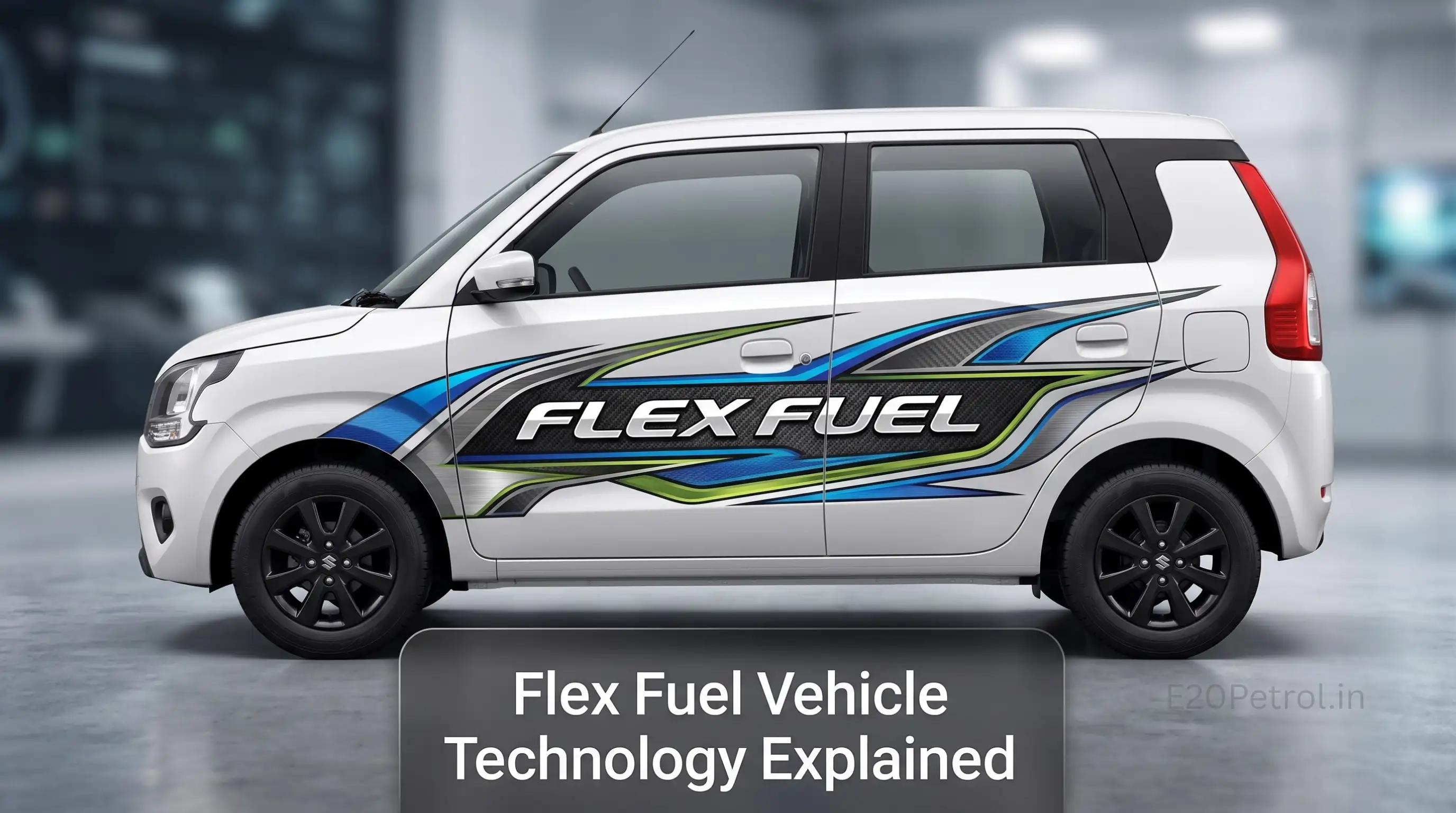
The Maruti Wagon R Flex Fuel was launched at Rs 7.24 lakh, Rs 86,000 more than the standard Wagon R petrol variant. It represents the first mass-market flex fuel passenger car in India and is positioned to benefit from the E85 station expansion roadmap. Upcoming FFV cars with confirmed timelines include the Maruti Fronx Flex Fuel, Tata Punch Flex Fuel, and Mahindra XUV 3XO FFV through the 2026 to 2027 period.
Why Brazil Matters - The Only Country That Has Done This at Scale
Brazil is the only country that has operated a nationwide flex fuel vehicle ecosystem at scale, and its trajectory is the closest operational precedent India has. The Brazilian Automobile Manufacturers Association, ANFAVEA, documented that Brazil introduced commercial flex fuel vehicles in 2003 and reached a point where over 90% of new petrol cars sold in the country were flex fuel capable within a decade. This adoption was driven by a combination of commercially priced ethanol derived from sugarcane and a retail infrastructure that made E85 and E100 genuinely available.
India’s starting point is different, sugarcane-derived 1G ethanol at scale, 48 E85 stations versus Brazil’s mature 45,000-station network, and a far larger legacy fleet of non-FFV vehicles. But the Brazilian precedent confirms that nationwide FFV adoption is technically and commercially achievable when retail fuel infrastructure and vehicle availability move in parallel. The government’s target of 5,000 E85 stations by December 2027 is the infrastructure signal that OEMs have cited as justification for their FFV launch commitments.
Sources
- MoRTH Gazette Notification G.S.R. 343(E), May 2021 - FFV Safety Guidelines
- AIS-171 - Safety Requirements for Type Approval of EBMG Vehicles, ARAI
- BIS IS 19850:2026 - Standards for E22, E25, E27, E30 - Vision IAS Current Affairs
- Hero MotoCorp Press Release - Flex Fuel Motorcycles Launch, June 2026
- Hero Splendor+ and HF Deluxe Flex Fuel Deliveries from July 2026 - India Today
- Maruti Suzuki WagonR Flex Fuel Launched at Rs 7.24 Lakh - V3Cars
- Suzuki Gixxer SF 250 Flex Fuel Launched at Rs 2.17 Lakh - Autocar India
- ANFAVEA - History and Technical Information, Brazilian Automobile Manufacturers Association
- PIB - Ethanol Blending in India, Press Release PRID 2281287
- The Flex Fuel Dilemma: All You Need to Know - BikeWale