Showing Posts From
Motorcycles
-
 Ajit Khandekar
 - 05 Jul, 2026
Is Your Bike BS4 or BS6? How to Check and Why It Matters for E20 Petrol
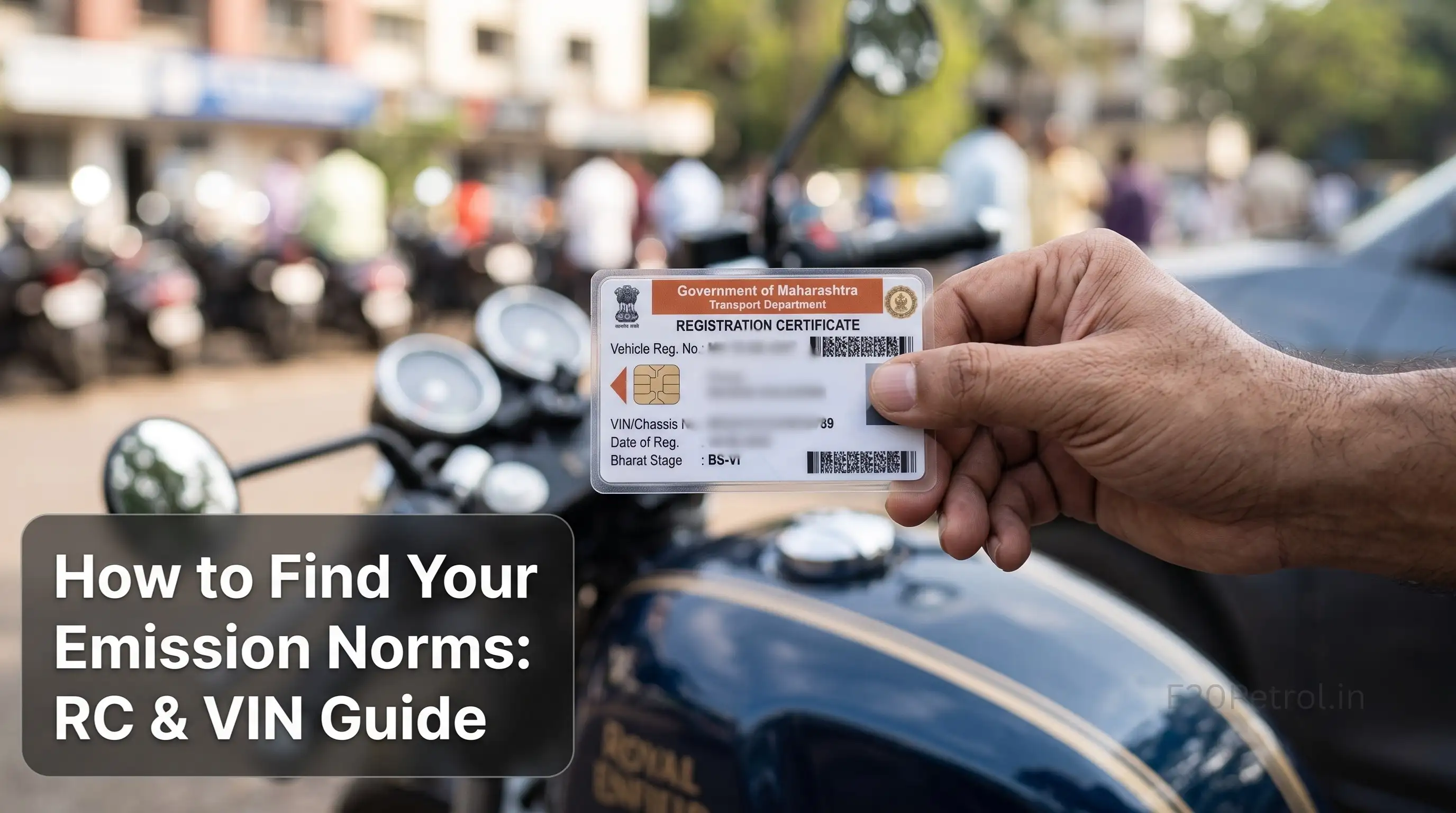
Since 1 April 2026, every petrol pump in India dispenses E20 as the sole standard fuel grade. Your motorcycle's emission standard (whether it is BS3, BS4, BS6 Phase 1, or BS6 Phase 2) determines how that fuel affects mileage, fuel system components, and long-term engine wear. A BS6 Phase 2 bike needs minimal intervention. A BS4 carburetted bike needs an active maintenance plan. And a BS3 bike carries the highest risk exposure of all. The problem is that most riders do not know their exact emission standard. The sticker on the bike is often worn. The owner manual references a model name, not an emission standard. And the terms BS4 and BS6 are used loosely in conversation without precision about Phase 1 versus Phase 2, a distinction that actually matters for E20 compatibility. This guide explains exactly where to find the emission standard for your motorcycle, what each classification means for E20, and what the government's own database will tell you. Table of ContentsWhere to Find Your Emission Standard - RC Card and VAHAN How to Read the VIN to Determine Manufacturing Year The Transition Dates - When BS4 Ended and BS6 Began What Each Standard Means for E20 Compatibility BS6 Phase 1 vs BS6 Phase 2 - A Difference That Actually Matters OEM Declarations on E20 Compatibility by Standard SourcesWhere to Find Your Emission Standard - RC Card and VAHAN The most direct source is your physical RC smart card, issued under Form 23A of the Central Motor Vehicles Rules (CMVR). On the card, look for the field labelled "Emission Norms." For a BS4 vehicle, this field reads "BS-IV" or "BHARAT STAGE IV." For a BS6 vehicle, it reads "BS-VI" or "BHARAT STAGE VI." The card does not distinguish Phase 1 from Phase 2, for that distinction, the manufacturing date is what matters, as explained below. If your physical RC card is worn, faded, or the field is not visible, the digital equivalent is available through two official channels. The first is the VAHAN NR e-Services portal, maintained by the Ministry of Road Transport and Highways. By entering your vehicle registration number and the last five digits of the chassis number, the system returns the full digital RC record including the "Emission Norms" or "Norms Type" field directly from the VAHAN central database. The second is the mParivahan mobile application, which provides the same query function. Both pull from the same VAHAN database, which is populated using Form 22, the manufacturer's Compliance to Emission and Noise Standards certificate submitted at the time of first registration. If the VAHAN query returns "BHARAT STAGE IV," your bike is a BS4. If it returns "BHARAT STAGE VI," it is BS6. The absence of any emission data in the VAHAN record for very old registrations typically indicates a pre-BS4 vehicle. How to Read the VIN to Determine Manufacturing Year The VIN is a 17-character alphanumeric code stamped on the vehicle frame, typically on the right side of the steering headstock or the main frame tube. The structural format follows Bureau of Indian Standards and Automotive Industry Standard AIS-065, which aligns with the international ISO 3779 standard. The 10th character of the VIN is the year of manufacture code. This is the character you need. There is no character dedicated to BS standard in the VIN, emission compliance is inferred from the manufacturing year, since BS transition dates are fixed and publicly documented. The 10th character follows a standardised alphanumeric sequence that excludes I, O, Q, U, and Z to prevent reading errors. The relevant year codes for the E20 era are as follows. The character "H" represents 2017. "J" represents 2018. "K" represents 2019. "L" represents 2020. "M" represents 2021. "N" represents 2022. "P" represents 2023. "R" represents 2024. "S" represents 2025. "V" represents 2026. A bike with "K" in the 10th position was manufactured in 2019, placing it firmly in the BS4 era. A bike with "M" in that position was manufactured in 2021 and is BS6 Phase 1. A bike with "P" was manufactured in 2023 and may be late BS6 Phase 1 or early Phase 2, depending on the exact month, Phase 2 began in April 2023. The characters in positions 1 to 3 are the World Manufacturer Identifier. For reference, "MD2" identifies Bajaj Auto, "ME3" identifies Royal Enfield, and "ME8" identifies Hero MotoCorp. These help confirm the manufacturer when cross-checking against production records. The Transition Dates - When BS4 Ended and BS6 Began These dates are fixed by MoRTH notification and determine which standard your bike falls under. BS4 emissions norms were mandatory for all new two-wheelers from 1 April 2017. The Supreme Court of India directed that no BS4 vehicles would be registered after 31 March 2020. The sale and registration of BS4 motorcycles therefore ended on that date, though some manufacturers received limited extensions for pre-manufactured stock. Any motorcycle first registered between 1 April 2017 and 31 March 2020 is a BS4 vehicle. BS6 Phase 1 began on 1 April 2020. Vehicles manufactured under this phase met BS6 emission targets but were calibrated for E10 fuel. Fuel system materials in BS6 Phase 1 vehicles were not mandated to be E20-compatible. Any motorcycle first registered between 1 April 2020 and 31 March 2023 is BS6 Phase 1. BS6 Phase 2, also referred to as BS6 OBD2B, began from April 2023. MoRTH mandated that all new vehicles type-approved from this date must comply with On-Board Diagnostics level 2B and be calibrated for E20 reference fuel as specified in BIS IS 17943:2022. Any motorcycle manufactured after 1 April 2023 is BS6 Phase 2 and is factory E20-compliant. What Each Standard Means for E20 Compatibility The emission standard is a proxy for the engineering decisions made when the motorcycle was designed and manufactured. Each standard corresponds to a different set of fuel system materials and ECU calibration strategies. BS3 and older motorcycles use mechanical carburettors with fully open-loop fuel delivery. There is no sensor feedback, no adaptive compensation, and fuel system materials predate any ethanol compatibility requirements. On E20, these bikes run lean, overheat, and face the highest risk of fuel line degradation and tank corrosion. The ARAI joint study documented mileage drops of 10% to 20% for this category. Riders in this segment should consider the Royal Enfield retrofit approach or consult the OEM directly before continuing on E20 for high-mileage use. BS4 motorcycles span two fuel delivery types. Carburetted BS4 bikes share the open-loop limitation of BS3 vehicles. Early fuel-injected BS4 bikes use narrow-band oxygen sensors and are better positioned than carburettors but still calibrated for pure petrol or low-ethanol blends. Mileage drops of 7% to 15% are the documented range, and nitrile rubber fuel system components are at risk. BS6 Phase 1 bikes have closed-loop fuel injection and can partially compensate for E20's oxygen content through sensor feedback. However, they were not calibrated for E20, so the compensation is imperfect. Mileage drops of 5% to 8% are typical. Injector deposits accumulate faster than on E20-calibrated engines. BS6 Phase 2 bikes are fully E20-compliant from the factory. ECUs are programmed with E20 reference fuel data, fuel system materials meet ethanol-compatibility specifications, and OBD2B diagnostics can flag fuel quality deviations. Mileage drops are in the 2% to 3% range and are attributable purely to ethanol's lower energy density, not to calibration mismatch. BS6 Phase 1 vs BS6 Phase 2 - A Difference That Actually Matters This distinction is consistently overlooked in media coverage of E20 but is practically significant. A Yamaha FZ-S purchased in 2021 is BS6 Phase 1. The same model purchased in mid-2023 or later is BS6 Phase 2. They look identical. They may have the same model name. But the Phase 2 version has different ECU calibration software, updated fuel injector specifications, and fuel system materials that passed E20 compatibility testing under BIS IS 17943:2022. The Phase 1 version has none of these. ARAI confirmed that BS6 Phase 1 vehicles see a 5% to 8% fuel efficiency penalty on E20 compared to 2% to 3% for Phase 2 vehicles. Over 10,000 km, that gap compounds to a meaningful cost difference. For Phase 1 bikes still under warranty, check with the OEM service centre about any software updates that may improve E20 compensation on their ECU. Some manufacturers have issued over-the-air or dealer-applied updates for this. The manufacturing date cutoff for Phase 2 is April 2023. If your BS6 bike's manufacturing date precedes this, treat it as Phase 1 for maintenance planning purposes. OEM Declarations on E20 Compatibility by Standard Hero MotoCorp has declared its BS6 Phase 2 lineup (including the XPulse 200, Xtreme 160R, and Glamour) as factory E20-compliant. The company has also launched dedicated flex fuel variants of the Splendor+ and HF Deluxe capable of running on E20 to E100, with deliveries starting July 2026 per the Hero MotoCorp press release dated 3 June 2026. Bajaj Auto, TVS Motor Company, Honda Motorcycle and Scooter India, and Yamaha India have all declared their BS6 Phase 2 models as E20-compliant. None of these manufacturers has issued a retroactive compatibility declaration for BS4 models. Royal Enfield occupies a distinct position. The Classic 350, Bullet 350, and Thunderbird 350 in BS4 configuration are acknowledged as needing fuel system retrofits for E20 compatibility, and the company has supplied conversion kits. The BS6 Phase 2 Classic 350 is factory E20-compliant and has been arriving at dealerships in this configuration since late 2023. Suzuki launched the Gixxer SF 250 Flex Fuel at Auto Expo 2025, priced at Rs 2.17 lakh, making it the first 250cc motorcycle in India with official flex fuel certification for E20 to E85 operation. If your OEM is not on this list, check the official brand website's E20 compatibility page or contact the authorised service centre with your VIN. The answer will differ by manufacturing date. SourcesMoRTH Form 23A CMVR - RC Smart Card Specifications MoRTH Form 22 - Compliance to Emission and Noise Standards BIS IS 17943:2022 - E20 Reference Fuel Specifications for Type Approval Hero MotoCorp Press Release - Flex Fuel Motorcycles Launch, June 2026 Hero Splendor+ and HF Deluxe Flex Fuel Launched, Deliveries from July 2026 - India Today Suzuki Gixxer SF 250 Flex Fuel Launched at Rs 2.17 Lakh - Autocar India ARAI Reaffirms Validation Standards for E20 - PIB E20-Compliant Royal Enfield Classic 350 at Dealerships - BikeWale Government Mandates 95 Octane E20 Petrol Across India from Today - NDTV Auto Automotive Industry Standard AIS-065 - VIN Structure, ISO 3779
- Ajit Khandekar
- 03 Jul, 2026
E20 Petrol and Your Motorcycle - What Every Indian Rider Needs to Know
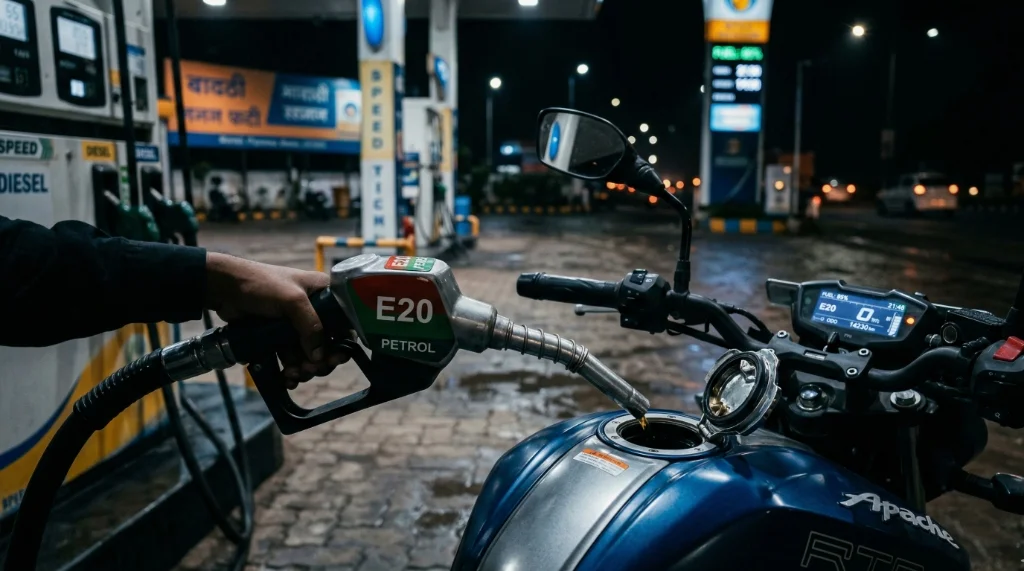
From 1 April 2026, every petrol pump in India dispenses E20 (petrol blended with up to 20% anhydrous ethanol) as the sole standard fuel grade. The change was mandated by the Ministry of Petroleum and Natural Gas through gazette notification S.O. 860(E) dated 17 February 2026, issued under Section 3 of the Essential Commodities Act, 1955. There is no low-ethanol alternative at the pump. E10 no longer exists. The only ethanol-free petrol available is XP100 or Power 100, priced at approximately Rs 160 per litre, and intended for a narrow set of use cases. For riders of 150cc to 450cc motorcycles, this is not a distant policy headline. It is a change to the fuel entering your engine at every refuel. Whether you ride a Royal Enfield Classic 350, a Bajaj Pulsar NS200, a KTM Duke 390, or a TVS Apache RTR 200, the question is the same: what does this fuel do to your machine, and what do you need to do about it? This guide answers that question by emission standard, engine type, and fuel system design, using data from ARAI, BIS, and OEM technical positions. Table of ContentsWhat E20 Actually Is - and What It Is Not How E20 Affects Mileage by BS Standard What Ethanol Does to Fuel System Components Phase Separation - Why Monsoon Season Raises the Stakes What the Government and OEMs Have Said A Practical Maintenance Plan for Your Motorcycle SourcesWhat E20 Actually Is - and What It Is Not E20 is a blend of 80% conventional petrol and 20% anhydrous ethanol by volume, supplied at a minimum Research Octane Number of 95 RON. The higher RON compared to the old 91 RON base fuel is a direct consequence of ethanol's naturally high octane rating of approximately 108.5 RON. When blended at 20% concentration, it raises the overall octane profile of the mix. This point matters for one common misconception: XP95 is not ethanol-free. Independent gas chromatography testing conducted per the ASTM D4815 standard confirmed that IOCL's XP95 contains 19.88% ethanol by volume (essentially identical to regular E20 petrol. XP95 and regular petrol now differ in additive packages and detergent levels, not in ethanol content. The only commercially available E0 fuels are XP100 and HPCL's Power 100, both 100-octane premium petrols that contain effectively no ethanol) independently measured at under 0.2 percent by volume. E10 is gone. If your owner manual says E10, that recommendation is now obsolete. The fuel it described is no longer available anywhere in India. How E20 Affects Mileage by BS Standard The mileage impact of E20 is real, measurable, and varies significantly by emission standard. The authoritative reference is the joint study conducted by ARAI, IOCL, and SIAM in 2021, which subjected vehicles to chassis dynamometer testing under controlled laboratory conditions. The 2021 NITI Aayog Ethanol Roadmap also published efficiency projections that have since been validated in field conditions. The core physics is straightforward. Anhydrous ethanol contains approximately 30% to 35% less energy per unit volume than petrol. At a 20% blend ratio, the overall energy content of E20 drops by roughly 3% to 3.5% compared to pure petrol. In engines calibrated to compensate for this via closed-loop feedback, the mileage penalty tracks closely to this theoretical loss. In engines that cannot compensate, the drop is larger. The practical impact by BS standard is as follows. BS6 Phase 2 motorcycles, those manufactured after April 2023, are factory E20-compliant. Their ECUs are calibrated for E20's oxygen-rich stoichiometry, and their fuel system materials are ethanol-resistant. Real-world mileage drops on these bikes sit in the 2% to 3% range. BS6 Phase 1 motorcycles (April 2020 to March 2023) use closed-loop fuel injection but were calibrated for E10. The mileage drop is higher, typically 5% to 8%, with some injector deposit accumulation over extended use. BS4 motorcycles (2017 to 2019) include both carburetted and early fuel injection variants. Carburetted BS4 bikes cannot adjust their air-fuel mixture dynamically, so they run lean on E20. Mileage drops of 7% to 15% are documented, along with increased operating temperatures. BS3 and older motorcycles show the steepest drops, 10% to 20% in ARAI and field data, with the highest risk of fuel system damage. A Royal Enfield Classic 350 BS4 owner doing 500 km per tank on E10 may now see that range fall to 425 to 465 km on E20. The calculation varies by riding conditions, but the directional impact is consistent. What Ethanol Does to Fuel System Components Ethanol is a polar solvent. This property, which makes it effective as a fuel oxygenate, also makes it chemically aggressive toward certain materials that were standard in motorcycles manufactured before the E20 era. The most critical vulnerability is nitrile rubber, also called NBR. Standard low-grade NBR was widely used for fuel hoses, float bowl gaskets, O-rings, and injector seals in BS3, BS4, and early BS6 Phase 1 motorcycles. Under continuous E20 exposure, NBR absorbs ethanol, swells, softens, and eventually cracks or leaks. Owners of older TVS Apache and Bajaj Avenger models have documented rubber fuel feed lines cracking and weeping fuel at the hose clamp joints. Swollen float bowl gaskets are a common carburetor complaint on BS4 carburetted bikes, causing fuel overflow and (critically) fire risk when fuel contacts a hot engine casing. Fuel tank corrosion is a separate concern. Ethanol is hygroscopic: it actively absorbs moisture from the air. Steel fuel tanks, particularly in bikes that sit partially fuelled for days or weeks, develop internal condensation as the ethanol-water mixture interacts with the tank lining. Riders on Team-BHP and BikeWale forums have documented rust flakes visible around fuel filler caps and on the tank floor. In fuel-injected motorcycles, these particles bypass coarse pump strainers, clog fuel injectors, cause RPM-dependent fuel starvation, and accelerate fuel pump motor wear. On carburetted bikes, rust contamination blocks jets and pilots. Fuel-injected motorcycles in the BS6 Phase 1 range (KTM Duke 390, Yamaha FZ-S V3, Honda CB300R) report a different symptom set: increased secondary vibrations at highway speeds after refuelling with E20, slight reduction in throttle response at the top of the rev range, and accumulation of injector deposits over 15,000 to 20,000 km. These bikes were not designed for E20 but handle it better than carburetted platforms due to their closed-loop feedback systems. Phase Separation - Why Monsoon Season Raises the Stakes Phase separation occurs when the water concentration dissolved in an ethanol-petrol blend crosses a threshold that causes the ethanol and water to separate from the hydrocarbons and sink to the bottom of the fuel tank as a dense, corrosive layer. BIS standard IS 2796:2017 specifies a maximum water tolerance of 10°C phase separation temperature for summer and non-winter conditions. India's monsoon season significantly raises the risk. Ethanol's hygroscopic nature means that a partially filled steel tank in a high-humidity environment (Maharashtra, Kerala, West Bengal, Assam between June and September) absorbs atmospheric moisture at a measurable rate. A tank that is 25% full has three times the headspace air volume of a tank at 75% capacity, and therefore three times the surface area available for moisture absorption and condensation. The consequence of phase separation entering the fuel system is severe. The water-ethanol layer at the tank bottom has essentially zero calorific value, causes immediate lean misfire if it enters the injector or carburettor jet, and rapidly corrodes any steel or zinc components it contacts. Prevention is straightforward: keep the tank at 90% or above capacity during extended parking, particularly during monsoon months. If the bike is being stored for more than three weeks, use a fuel stabiliser or drain the tank and carburettor bowl entirely. What the Government and OEMs Have Said The official government position is that E20 poses no significant risk of engine failure or widespread damage to legacy vehicles. At a government press conference on 4 July 2026, Maruti Suzuki presented data from 2.84 crore vehicles serviced through its official network in FY 2025-26, stating that no verified cases of E20-related corrosion or fuel pump failure were documented. The OEM position on motorcycles is more nuanced. Royal Enfield has offered E20 retrofit kits for the Classic 350, Bullet 350, and Thunderbird 350 BS4 models, priced between Rs 1,700 and Rs 4,000. The existence of a retrofit kit is itself an acknowledgement that the original fuel system components are not E20-ready. Hero MotoCorp has stated that BS6 Phase 2 models are fully E20-compliant from the factory. Bajaj, TVS, Yamaha, and Honda have made similar declarations for their post-April 2023 lineups, while not issuing retroactive compatibility guarantees for BS4 vehicles. The critical tension is this: the 2021 NITI Aayog Ethanol Roadmap explicitly recommended that "E10 should be made available on a pan-India basis as a protection-grade fuel for the existing pool of legacy vehicles." That recommendation was overruled to accelerate the E20 rollout. BS4 and older motorcycle owners now run on a fuel their engines were not designed for, with no standard-grade alternative available and no official mechanism for compensation if components degrade. A Practical Maintenance Plan for Your Motorcycle The maintenance response to E20 depends on your bike's emission standard. BS6 Phase 2 bikes require the least intervention, follow the OEM service schedule, consider using an ethanol-compatible fuel additive every 5,000 km, and monitor injector performance at the 30,000 km mark. BS6 Phase 1 bikes should add a fuel system cleaner every 8,000 to 10,000 km and inspect injector deposits at the 20,000 km service. Change the fuel filter on schedule. BS4 bikes require the most proactive response. The highest-priority action is fuel hose inspection and replacement. Any hose that shows surface cracking, softening, or fuel seepage at clamp points should be replaced immediately with Viton FKM hoses, fluorinated elastomers that are chemically resistant to ethanol at all blend concentrations. Standard NBR hoses should be treated as a scheduled replacement item at 10,000 km or 12 months, whichever comes first. O-rings and injector seals should follow the same interval using high-grade silicone or Viton replacements. Carburettor cleaning is now a more frequent requirement than manufacturer schedules reflect. On BS4 carburetted bikes, aim for a full carburettor disassembly and jet cleaning every 10,000 km or when rough idling appears. Fuel filter replacement should move to every 8,000 km rather than the typical 15,000 km factory interval. Treat the tank with an ethanol-specific fuel stabiliser containing corrosion inhibitors at each refuel if the bike sits for more than three to five days between rides. For any BS4 bike being stored for more than three weeks, drain the fuel tank and carburettor float bowl completely. E20 left in a partially filled tank during an extended parking period is the single fastest path to phase separation damage and internal tank corrosion. Keep all service records, they form the evidence trail if you need to raise a dispute. SourcesMoPNG Gazette Notification S.O. 860(E), February 2026 - Direction for Sale of E20 Petrol with RON 95 PIB - Ethanol Blending in India, Press Release PRID 2281287 ARAI Reaffirms Validation Standards for E20 Ethanol-Blended Fuel - PIB, PRID 2281084 Autocar India - How Much Ethanol Is in Your Petrol? Royal Enfield E20 Conversion Kits for Classic 350, Bullet 350 and Thunderbird 350 - BikeWale Government Defends E20 Rollout Amid Rising Consumer Backlash - Autocar Professional E20 Petrol: Safe if Managed Correctly - BikeWale ARAI Journal - Impact of E20 on Metals and Non-Metals in Fuel System Components E20 Ethanol Fuel in India: What It Does to Your Engine - RawTorque Government Mandates 95 Octane E20 Petrol Across India - NDTV Auto