Is Your Bike BS4 or BS6? How to Check and Why It Matters for E20 Petrol
-
 Ajit Khandekar
 - 05 Jul, 2026
Since 1 April 2026, every petrol pump in India dispenses E20 as the sole standard fuel grade. Your motorcycle’s emission standard (whether it is BS3, BS4, BS6 Phase 1, or BS6 Phase 2) determines how that fuel affects mileage, fuel system components, and long-term engine wear. A BS6 Phase 2 bike needs minimal intervention. A BS4 carburetted bike needs an active maintenance plan. And a BS3 bike carries the highest risk exposure of all.
The problem is that most riders do not know their exact emission standard. The sticker on the bike is often worn. The owner manual references a model name, not an emission standard. And the terms BS4 and BS6 are used loosely in conversation without precision about Phase 1 versus Phase 2, a distinction that actually matters for E20 compatibility.
This guide explains exactly where to find the emission standard for your motorcycle, what each classification means for E20, and what the government’s own database will tell you.
Table of Contents
- Where to Find Your Emission Standard - RC Card and VAHAN
- How to Read the VIN to Determine Manufacturing Year
- The Transition Dates - When BS4 Ended and BS6 Began
- What Each Standard Means for E20 Compatibility
- BS6 Phase 1 vs BS6 Phase 2 - A Difference That Actually Matters
- OEM Declarations on E20 Compatibility by Standard
- Sources
Where to Find Your Emission Standard - RC Card and VAHAN
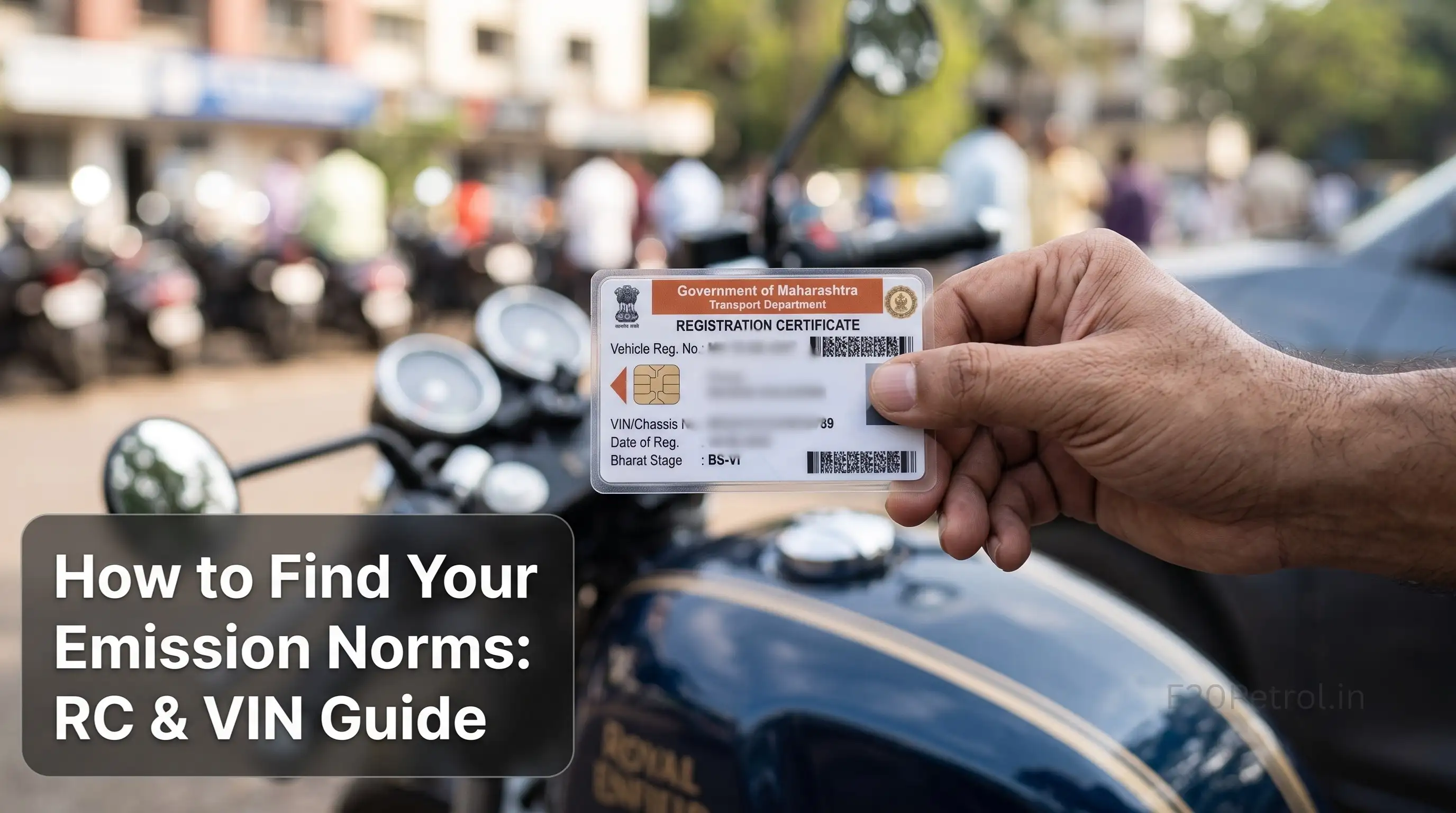
The most direct source is your physical RC smart card, issued under Form 23A of the Central Motor Vehicles Rules (CMVR). On the card, look for the field labelled “Emission Norms.” For a BS4 vehicle, this field reads “BS-IV” or “BHARAT STAGE IV.” For a BS6 vehicle, it reads “BS-VI” or “BHARAT STAGE VI.” The card does not distinguish Phase 1 from Phase 2, for that distinction, the manufacturing date is what matters, as explained below.
If your physical RC card is worn, faded, or the field is not visible, the digital equivalent is available through two official channels. The first is the VAHAN NR e-Services portal, maintained by the Ministry of Road Transport and Highways. By entering your vehicle registration number and the last five digits of the chassis number, the system returns the full digital RC record including the “Emission Norms” or “Norms Type” field directly from the VAHAN central database. The second is the mParivahan mobile application, which provides the same query function. Both pull from the same VAHAN database, which is populated using Form 22, the manufacturer’s Compliance to Emission and Noise Standards certificate submitted at the time of first registration.
If the VAHAN query returns “BHARAT STAGE IV,” your bike is a BS4. If it returns “BHARAT STAGE VI,” it is BS6. The absence of any emission data in the VAHAN record for very old registrations typically indicates a pre-BS4 vehicle.
How to Read the VIN to Determine Manufacturing Year
The VIN is a 17-character alphanumeric code stamped on the vehicle frame, typically on the right side of the steering headstock or the main frame tube. The structural format follows Bureau of Indian Standards and Automotive Industry Standard AIS-065, which aligns with the international ISO 3779 standard.
The 10th character of the VIN is the year of manufacture code. This is the character you need. There is no character dedicated to BS standard in the VIN, emission compliance is inferred from the manufacturing year, since BS transition dates are fixed and publicly documented. The 10th character follows a standardised alphanumeric sequence that excludes I, O, Q, U, and Z to prevent reading errors.
The relevant year codes for the E20 era are as follows. The character “H” represents 2017. “J” represents 2018. “K” represents 2019. “L” represents 2020. “M” represents 2021. “N” represents 2022. “P” represents 2023. “R” represents 2024. “S” represents 2025. “V” represents 2026.
A bike with “K” in the 10th position was manufactured in 2019, placing it firmly in the BS4 era. A bike with “M” in that position was manufactured in 2021 and is BS6 Phase 1. A bike with “P” was manufactured in 2023 and may be late BS6 Phase 1 or early Phase 2, depending on the exact month, Phase 2 began in April 2023.
The characters in positions 1 to 3 are the World Manufacturer Identifier. For reference, “MD2” identifies Bajaj Auto, “ME3” identifies Royal Enfield, and “ME8” identifies Hero MotoCorp. These help confirm the manufacturer when cross-checking against production records.
The Transition Dates - When BS4 Ended and BS6 Began
These dates are fixed by MoRTH notification and determine which standard your bike falls under.
BS4 emissions norms were mandatory for all new two-wheelers from 1 April 2017. The Supreme Court of India directed that no BS4 vehicles would be registered after 31 March 2020. The sale and registration of BS4 motorcycles therefore ended on that date, though some manufacturers received limited extensions for pre-manufactured stock. Any motorcycle first registered between 1 April 2017 and 31 March 2020 is a BS4 vehicle.
BS6 Phase 1 began on 1 April 2020. Vehicles manufactured under this phase met BS6 emission targets but were calibrated for E10 fuel. Fuel system materials in BS6 Phase 1 vehicles were not mandated to be E20-compatible. Any motorcycle first registered between 1 April 2020 and 31 March 2023 is BS6 Phase 1.
BS6 Phase 2, also referred to as BS6 OBD2B, began from April 2023. MoRTH mandated that all new vehicles type-approved from this date must comply with On-Board Diagnostics level 2B and be calibrated for E20 reference fuel as specified in BIS IS 17943:2022. Any motorcycle manufactured after 1 April 2023 is BS6 Phase 2 and is factory E20-compliant.
What Each Standard Means for E20 Compatibility
The emission standard is a proxy for the engineering decisions made when the motorcycle was designed and manufactured. Each standard corresponds to a different set of fuel system materials and ECU calibration strategies.
BS3 and older motorcycles use mechanical carburettors with fully open-loop fuel delivery. There is no sensor feedback, no adaptive compensation, and fuel system materials predate any ethanol compatibility requirements. On E20, these bikes run lean, overheat, and face the highest risk of fuel line degradation and tank corrosion. The ARAI joint study documented mileage drops of 10% to 20% for this category. Riders in this segment should consider the Royal Enfield retrofit approach or consult the OEM directly before continuing on E20 for high-mileage use.
BS4 motorcycles span two fuel delivery types. Carburetted BS4 bikes share the open-loop limitation of BS3 vehicles. Early fuel-injected BS4 bikes use narrow-band oxygen sensors and are better positioned than carburettors but still calibrated for pure petrol or low-ethanol blends. Mileage drops of 7% to 15% are the documented range, and nitrile rubber fuel system components are at risk.
BS6 Phase 1 bikes have closed-loop fuel injection and can partially compensate for E20’s oxygen content through sensor feedback. However, they were not calibrated for E20, so the compensation is imperfect. Mileage drops of 5% to 8% are typical. Injector deposits accumulate faster than on E20-calibrated engines.
BS6 Phase 2 bikes are fully E20-compliant from the factory. ECUs are programmed with E20 reference fuel data, fuel system materials meet ethanol-compatibility specifications, and OBD2B diagnostics can flag fuel quality deviations. Mileage drops are in the 2% to 3% range and are attributable purely to ethanol’s lower energy density, not to calibration mismatch.
BS6 Phase 1 vs BS6 Phase 2 - A Difference That Actually Matters
This distinction is consistently overlooked in media coverage of E20 but is practically significant. A Yamaha FZ-S purchased in 2021 is BS6 Phase 1. The same model purchased in mid-2023 or later is BS6 Phase 2. They look identical. They may have the same model name. But the Phase 2 version has different ECU calibration software, updated fuel injector specifications, and fuel system materials that passed E20 compatibility testing under BIS IS 17943:2022. The Phase 1 version has none of these.
ARAI confirmed that BS6 Phase 1 vehicles see a 5% to 8% fuel efficiency penalty on E20 compared to 2% to 3% for Phase 2 vehicles. Over 10,000 km, that gap compounds to a meaningful cost difference. For Phase 1 bikes still under warranty, check with the OEM service centre about any software updates that may improve E20 compensation on their ECU. Some manufacturers have issued over-the-air or dealer-applied updates for this.
The manufacturing date cutoff for Phase 2 is April 2023. If your BS6 bike’s manufacturing date precedes this, treat it as Phase 1 for maintenance planning purposes.
OEM Declarations on E20 Compatibility by Standard
Hero MotoCorp has declared its BS6 Phase 2 lineup (including the XPulse 200, Xtreme 160R, and Glamour) as factory E20-compliant. The company has also launched dedicated flex fuel variants of the Splendor+ and HF Deluxe capable of running on E20 to E100, with deliveries starting July 2026 per the Hero MotoCorp press release dated 3 June 2026.
Bajaj Auto, TVS Motor Company, Honda Motorcycle and Scooter India, and Yamaha India have all declared their BS6 Phase 2 models as E20-compliant. None of these manufacturers has issued a retroactive compatibility declaration for BS4 models.
Royal Enfield occupies a distinct position. The Classic 350, Bullet 350, and Thunderbird 350 in BS4 configuration are acknowledged as needing fuel system retrofits for E20 compatibility, and the company has supplied conversion kits. The BS6 Phase 2 Classic 350 is factory E20-compliant and has been arriving at dealerships in this configuration since late 2023.
Suzuki launched the Gixxer SF 250 Flex Fuel at Auto Expo 2025, priced at Rs 2.17 lakh, making it the first 250cc motorcycle in India with official flex fuel certification for E20 to E85 operation.
If your OEM is not on this list, check the official brand website’s E20 compatibility page or contact the authorised service centre with your VIN. The answer will differ by manufacturing date.
Sources
- MoRTH Form 23A CMVR - RC Smart Card Specifications
- MoRTH Form 22 - Compliance to Emission and Noise Standards
- BIS IS 17943:2022 - E20 Reference Fuel Specifications for Type Approval
- Hero MotoCorp Press Release - Flex Fuel Motorcycles Launch, June 2026
- Hero Splendor+ and HF Deluxe Flex Fuel Launched, Deliveries from July 2026 - India Today
- Suzuki Gixxer SF 250 Flex Fuel Launched at Rs 2.17 Lakh - Autocar India
- ARAI Reaffirms Validation Standards for E20 - PIB
- E20-Compliant Royal Enfield Classic 350 at Dealerships - BikeWale
- Government Mandates 95 Octane E20 Petrol Across India from Today - NDTV Auto
- Automotive Industry Standard AIS-065 - VIN Structure, ISO 3779