Showing Posts From
How to
-
 Ajit Khandekar
 - 05 Jul, 2026
Is Your Bike BS4 or BS6? How to Check and Why It Matters for E20 Petrol
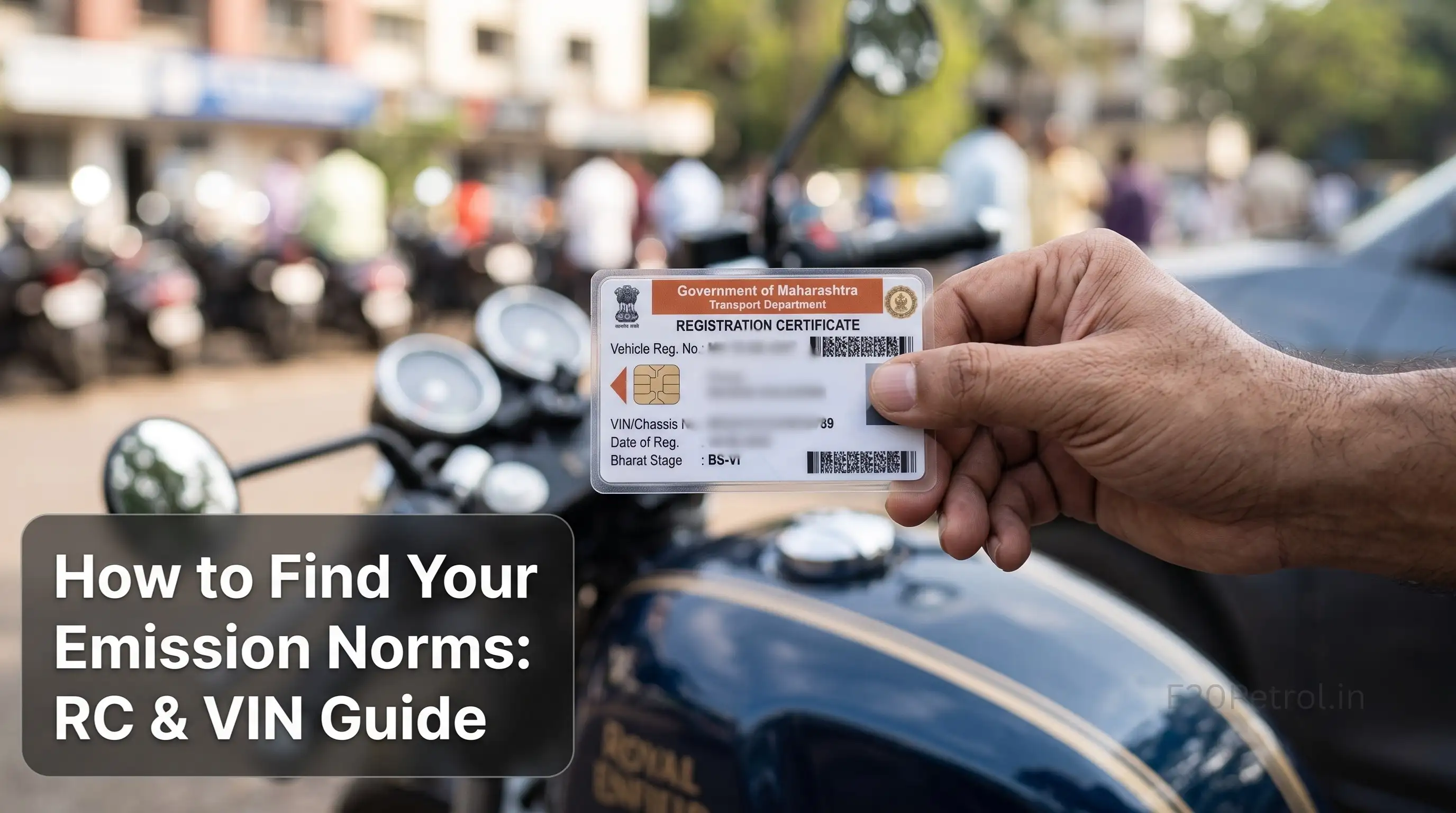
Since 1 April 2026, every petrol pump in India dispenses E20 as the sole standard fuel grade. Your motorcycle's emission standard (whether it is BS3, BS4, BS6 Phase 1, or BS6 Phase 2) determines how that fuel affects mileage, fuel system components, and long-term engine wear. A BS6 Phase 2 bike needs minimal intervention. A BS4 carburetted bike needs an active maintenance plan. And a BS3 bike carries the highest risk exposure of all. The problem is that most riders do not know their exact emission standard. The sticker on the bike is often worn. The owner manual references a model name, not an emission standard. And the terms BS4 and BS6 are used loosely in conversation without precision about Phase 1 versus Phase 2, a distinction that actually matters for E20 compatibility. This guide explains exactly where to find the emission standard for your motorcycle, what each classification means for E20, and what the government's own database will tell you. Table of ContentsWhere to Find Your Emission Standard - RC Card and VAHAN How to Read the VIN to Determine Manufacturing Year The Transition Dates - When BS4 Ended and BS6 Began What Each Standard Means for E20 Compatibility BS6 Phase 1 vs BS6 Phase 2 - A Difference That Actually Matters OEM Declarations on E20 Compatibility by Standard SourcesWhere to Find Your Emission Standard - RC Card and VAHAN The most direct source is your physical RC smart card, issued under Form 23A of the Central Motor Vehicles Rules (CMVR). On the card, look for the field labelled "Emission Norms." For a BS4 vehicle, this field reads "BS-IV" or "BHARAT STAGE IV." For a BS6 vehicle, it reads "BS-VI" or "BHARAT STAGE VI." The card does not distinguish Phase 1 from Phase 2, for that distinction, the manufacturing date is what matters, as explained below. If your physical RC card is worn, faded, or the field is not visible, the digital equivalent is available through two official channels. The first is the VAHAN NR e-Services portal, maintained by the Ministry of Road Transport and Highways. By entering your vehicle registration number and the last five digits of the chassis number, the system returns the full digital RC record including the "Emission Norms" or "Norms Type" field directly from the VAHAN central database. The second is the mParivahan mobile application, which provides the same query function. Both pull from the same VAHAN database, which is populated using Form 22, the manufacturer's Compliance to Emission and Noise Standards certificate submitted at the time of first registration. If the VAHAN query returns "BHARAT STAGE IV," your bike is a BS4. If it returns "BHARAT STAGE VI," it is BS6. The absence of any emission data in the VAHAN record for very old registrations typically indicates a pre-BS4 vehicle. How to Read the VIN to Determine Manufacturing Year The VIN is a 17-character alphanumeric code stamped on the vehicle frame, typically on the right side of the steering headstock or the main frame tube. The structural format follows Bureau of Indian Standards and Automotive Industry Standard AIS-065, which aligns with the international ISO 3779 standard. The 10th character of the VIN is the year of manufacture code. This is the character you need. There is no character dedicated to BS standard in the VIN, emission compliance is inferred from the manufacturing year, since BS transition dates are fixed and publicly documented. The 10th character follows a standardised alphanumeric sequence that excludes I, O, Q, U, and Z to prevent reading errors. The relevant year codes for the E20 era are as follows. The character "H" represents 2017. "J" represents 2018. "K" represents 2019. "L" represents 2020. "M" represents 2021. "N" represents 2022. "P" represents 2023. "R" represents 2024. "S" represents 2025. "V" represents 2026. A bike with "K" in the 10th position was manufactured in 2019, placing it firmly in the BS4 era. A bike with "M" in that position was manufactured in 2021 and is BS6 Phase 1. A bike with "P" was manufactured in 2023 and may be late BS6 Phase 1 or early Phase 2, depending on the exact month, Phase 2 began in April 2023. The characters in positions 1 to 3 are the World Manufacturer Identifier. For reference, "MD2" identifies Bajaj Auto, "ME3" identifies Royal Enfield, and "ME8" identifies Hero MotoCorp. These help confirm the manufacturer when cross-checking against production records. The Transition Dates - When BS4 Ended and BS6 Began These dates are fixed by MoRTH notification and determine which standard your bike falls under. BS4 emissions norms were mandatory for all new two-wheelers from 1 April 2017. The Supreme Court of India directed that no BS4 vehicles would be registered after 31 March 2020. The sale and registration of BS4 motorcycles therefore ended on that date, though some manufacturers received limited extensions for pre-manufactured stock. Any motorcycle first registered between 1 April 2017 and 31 March 2020 is a BS4 vehicle. BS6 Phase 1 began on 1 April 2020. Vehicles manufactured under this phase met BS6 emission targets but were calibrated for E10 fuel. Fuel system materials in BS6 Phase 1 vehicles were not mandated to be E20-compatible. Any motorcycle first registered between 1 April 2020 and 31 March 2023 is BS6 Phase 1. BS6 Phase 2, also referred to as BS6 OBD2B, began from April 2023. MoRTH mandated that all new vehicles type-approved from this date must comply with On-Board Diagnostics level 2B and be calibrated for E20 reference fuel as specified in BIS IS 17943:2022. Any motorcycle manufactured after 1 April 2023 is BS6 Phase 2 and is factory E20-compliant. What Each Standard Means for E20 Compatibility The emission standard is a proxy for the engineering decisions made when the motorcycle was designed and manufactured. Each standard corresponds to a different set of fuel system materials and ECU calibration strategies. BS3 and older motorcycles use mechanical carburettors with fully open-loop fuel delivery. There is no sensor feedback, no adaptive compensation, and fuel system materials predate any ethanol compatibility requirements. On E20, these bikes run lean, overheat, and face the highest risk of fuel line degradation and tank corrosion. The ARAI joint study documented mileage drops of 10% to 20% for this category. Riders in this segment should consider the Royal Enfield retrofit approach or consult the OEM directly before continuing on E20 for high-mileage use. BS4 motorcycles span two fuel delivery types. Carburetted BS4 bikes share the open-loop limitation of BS3 vehicles. Early fuel-injected BS4 bikes use narrow-band oxygen sensors and are better positioned than carburettors but still calibrated for pure petrol or low-ethanol blends. Mileage drops of 7% to 15% are the documented range, and nitrile rubber fuel system components are at risk. BS6 Phase 1 bikes have closed-loop fuel injection and can partially compensate for E20's oxygen content through sensor feedback. However, they were not calibrated for E20, so the compensation is imperfect. Mileage drops of 5% to 8% are typical. Injector deposits accumulate faster than on E20-calibrated engines. BS6 Phase 2 bikes are fully E20-compliant from the factory. ECUs are programmed with E20 reference fuel data, fuel system materials meet ethanol-compatibility specifications, and OBD2B diagnostics can flag fuel quality deviations. Mileage drops are in the 2% to 3% range and are attributable purely to ethanol's lower energy density, not to calibration mismatch. BS6 Phase 1 vs BS6 Phase 2 - A Difference That Actually Matters This distinction is consistently overlooked in media coverage of E20 but is practically significant. A Yamaha FZ-S purchased in 2021 is BS6 Phase 1. The same model purchased in mid-2023 or later is BS6 Phase 2. They look identical. They may have the same model name. But the Phase 2 version has different ECU calibration software, updated fuel injector specifications, and fuel system materials that passed E20 compatibility testing under BIS IS 17943:2022. The Phase 1 version has none of these. ARAI confirmed that BS6 Phase 1 vehicles see a 5% to 8% fuel efficiency penalty on E20 compared to 2% to 3% for Phase 2 vehicles. Over 10,000 km, that gap compounds to a meaningful cost difference. For Phase 1 bikes still under warranty, check with the OEM service centre about any software updates that may improve E20 compensation on their ECU. Some manufacturers have issued over-the-air or dealer-applied updates for this. The manufacturing date cutoff for Phase 2 is April 2023. If your BS6 bike's manufacturing date precedes this, treat it as Phase 1 for maintenance planning purposes. OEM Declarations on E20 Compatibility by Standard Hero MotoCorp has declared its BS6 Phase 2 lineup (including the XPulse 200, Xtreme 160R, and Glamour) as factory E20-compliant. The company has also launched dedicated flex fuel variants of the Splendor+ and HF Deluxe capable of running on E20 to E100, with deliveries starting July 2026 per the Hero MotoCorp press release dated 3 June 2026. Bajaj Auto, TVS Motor Company, Honda Motorcycle and Scooter India, and Yamaha India have all declared their BS6 Phase 2 models as E20-compliant. None of these manufacturers has issued a retroactive compatibility declaration for BS4 models. Royal Enfield occupies a distinct position. The Classic 350, Bullet 350, and Thunderbird 350 in BS4 configuration are acknowledged as needing fuel system retrofits for E20 compatibility, and the company has supplied conversion kits. The BS6 Phase 2 Classic 350 is factory E20-compliant and has been arriving at dealerships in this configuration since late 2023. Suzuki launched the Gixxer SF 250 Flex Fuel at Auto Expo 2025, priced at Rs 2.17 lakh, making it the first 250cc motorcycle in India with official flex fuel certification for E20 to E85 operation. If your OEM is not on this list, check the official brand website's E20 compatibility page or contact the authorised service centre with your VIN. The answer will differ by manufacturing date. SourcesMoRTH Form 23A CMVR - RC Smart Card Specifications MoRTH Form 22 - Compliance to Emission and Noise Standards BIS IS 17943:2022 - E20 Reference Fuel Specifications for Type Approval Hero MotoCorp Press Release - Flex Fuel Motorcycles Launch, June 2026 Hero Splendor+ and HF Deluxe Flex Fuel Launched, Deliveries from July 2026 - India Today Suzuki Gixxer SF 250 Flex Fuel Launched at Rs 2.17 Lakh - Autocar India ARAI Reaffirms Validation Standards for E20 - PIB E20-Compliant Royal Enfield Classic 350 at Dealerships - BikeWale Government Mandates 95 Octane E20 Petrol Across India from Today - NDTV Auto Automotive Industry Standard AIS-065 - VIN Structure, ISO 3779
-
 Editorial Team
 - 01 Jul, 2026
The 3:1 Tank Method, Does Mixing XP100 With Regular Petrol Actually Help?
In the months since E20 became mandatory, a specific refuelling strategy has spread through Indian automotive communities on Team-BHP, Reddit's r/CarsIndia, and various RE owner forums. It goes like this: fill up with regular E20 petrol for three tanks, then fill the fourth with XP100. Repeat indefinitely. The logic behind it is intuitive. XP100 is ethanol-free and contains high-quality detergent additives. Three tanks of E20 followed by one of XP100 dilutes the average ethanol exposure and periodically flushes the injectors or carburettor with a premium, ethanol-free fuel. At roughly one-quarter of the cost of running XP100 full-time, it sounds like a sensible compromise. Is the chemistry behind this method sound? For some vehicle types, partially. For others, the method addresses the wrong problem. This article breaks it down. Table of ContentsWhat the 3:1 Method Is Trying to Achieve The Injector Flushing Argument, Does It Hold? The Ethanol Dilution Argument, What Actually Happens in the Tank Who the Method Actually Helps Who the Method Does Not Help The Cost Calculation Better Alternatives for Specific Problems SourcesWhat the 3:1 Method Is Trying to Achieve The 3:1 method attempts to solve two distinct problems simultaneously, and understanding which problem applies to your vehicle is the key to evaluating whether the method makes sense. The first problem is injector fouling. Modern GDI and TGDI engines accumulate carbon deposits on fuel injectors and intake valves over time, particularly when running on E20. The detergent additive packages in premium fuels, both XP95 and XP100, are formulated to dissolve these deposits and maintain clean injector spray patterns. Running a periodic tank of a high-detergent fuel is a documented maintenance strategy in markets where fuel quality is variable. The second problem is ethanol exposure in vulnerable fuel systems. Older vehicles with nitrile rubber seals, untreated steel tanks, and carburetted fuel delivery are at risk of corrosion and elastomer degradation from continuous E20 use. The theory is that introducing a tank of E0 XP100 periodically dilutes the effective ethanol concentration the fuel system sees over time. Both objectives are real. Whether the 3:1 method achieves them effectively depends on the specific failure mode you are trying to prevent. The Injector Flushing Argument, Does It Hold? For fuel-injected engines, particularly GDI and TGDI units, there is a rational basis for periodic premium fuel use as a cleaning strategy. XP100's additive package includes detergent compounds that target injector deposits. Running a full tank of XP100 every three to four tanks means that roughly 25% of the fuel passing through the injectors contains these detergents at full concentration. The effectiveness depends on whether the detergent concentration is sufficient to dissolve existing deposits during a single tank's worth of operation, or whether it simply maintains cleanliness in an already-clean system. For the latter, a newer BS6 Phase 2 engine with minimal deposit build-up, the method provides incremental maintenance benefit. For an older BS6 Phase 1 engine that has accumulated deposits over 30,000 km of E20 use, a single tank of XP100 may not be sufficient to meaningfully reduce existing fouling. It is also worth noting that XP95 carries a similar detergent additive package to XP100. If the objective is purely injector cleanliness, running XP95 consistently is cheaper and provides continuous detergent action rather than periodic bursts. The specific advantage of XP100 over XP95 in the cleaning context is the absence of ethanol, for some deposit types, ethanol's solvent properties are actually beneficial for cleaning, though ethanol also contributes to some deposit formation mechanisms on intake valves in GDI engines. For carburetted engines, the injector flushing argument does not apply. A carburettor has no injectors to foul. The relevant components, jets, pilots, needle, float bowl, can benefit from a detergent fuel, but the cleaning effect of a premium fuel on a carburettor is minimal compared to a physical carburettor disassembly and cleaning. The Ethanol Dilution Argument, What Actually Happens in the Tank This is where the method requires more careful thinking. The premise is that one tank of E0 XP100 every four tanks reduces the average ethanol concentration the fuel system experiences. Let us follow the chemistry. A typical motorcycle tank holds 12 to 15 litres. At tank three of E20, the system contains approximately 2.4 to 3 litres of ethanol (20% of 12 to 15 litres). When you fill the fourth tank with XP100, you add 12 to 15 litres of E0 to whatever E20 remains in the tank, perhaps 1 to 2 litres at low fuel warning. The resulting mix in the fourth tank is approximately 90% XP100 and 10% residual E20. The ethanol concentration in that tank drops to roughly 2%, effectively negligible. For the one tank that contains XP100, yes, the ethanol exposure is dramatically reduced. But the fuel system components, the hoses, the seals, the float bowl gasket, have been in contact with E20 for the three preceding tanks. The nitrile rubber degradation process in those three tanks is not reversed by the subsequent E0 tank. Nitrile rubber absorbs ethanol and swells progressively. Each E20 tank advances that degradation. The XP100 tank does not un-swell the rubber or repair micro-cracking that has already occurred. The dilution argument works best as a prevention strategy before significant degradation has occurred, not as a remediation strategy once the fuel system has been exposed to several thousand kilometres of E20. And as a prevention strategy, it competes against the more permanent solution of simply replacing NBR components with Viton FKM equivalents from the start. Who the Method Actually Helps The 3:1 method has genuine value in a specific, narrow set of scenarios. Owners of high-compression performance vehicles (Volkswagen EA888 Evo4, BMW inline-six turbos, high-displacement sports bikes above 400cc) who cannot justify full-time XP100 on cost grounds but want periodic optimal combustion. One tank of XP100 in four means the engine operates at full ECU timing advance for roughly 25% of its running hours, better than never, and meaningfully cheaper than constant XP100 use. Owners of vintage or classic vehicles who use their vehicles occasionally, weekend rides, monthly runs, rather than daily. For a bike covering 200 km per month, one XP100 fill per four months adds approximately Rs 600 to Rs 800 in fuel cost per year. The ethanol-free exposure during actual running is more consistent because the vehicle is not sitting with E20 in the tank for extended periods between the XP100 fills. Owners who are transitioning from a vulnerable fuel system (pre-Viton hoses, original steel tank) to a properly upgraded one and want to reduce ethanol load during the transition period. Once the Viton hoses are fitted, the ethanol dilution objective of the 3:1 method is no longer necessary. Who the Method Does Not Help Owners of commuter motorcycles and standard naturally aspirated cars. As covered in the XP95 vs XP100 article, these engines cannot use 100 RON's additional knock resistance, so the XP100 portion of the 3:1 cycle provides no performance or efficiency benefit. The ethanol dilution benefit is outweighed by the cost. Owners who are using the method as a substitute for fuel system repairs that are actually needed. If your BS4 bike's nitrile hoses are already cracking and leaking, rotating through XP100 tanks does not slow the degradation meaningfully. The hoses need replacement. Owners of BS6 Phase 2 vehicles with fully E20-compatible fuel systems. These vehicles do not have an ethanol vulnerability the method is protecting against. XP95 full-time is the better choice, same detergent benefit, lower cost, consistent protection. The Cost Calculation The financial difference between the 3:1 method and full-time E20 use depends on your vehicle's fuel consumption and local prices. For a motorcycle using 15 litres per fill covering approximately 600 km, the 3:1 cycle means one XP100 fill every 1,800 km. At Rs 160 per litre for XP100 versus Rs 105 for E20, one XP100 fill adds Rs 825 to the cost of four tanks (Rs 160 × 15 = Rs 2,400 vs Rs 105 × 15 = Rs 1,575, difference Rs 825). Spread across 1,800 km, the 3:1 method adds approximately Rs 0.46 per km over full E20 operation. For a car using 40 litres per fill, one XP100 fill every three E20 fills adds Rs 2,200 to the four-tank cycle cost (Rs 160 × 40 = Rs 6,400 vs Rs 105 × 40 = Rs 4,200, difference Rs 2,200). Spread across approximately 1,600 km (four fills at 400 km range), the additional cost is Rs 1.37 per km. Whether this additional cost is justified depends entirely on which of the method's objectives applies to your vehicle, and whether those objectives cannot be achieved more cost-effectively through other means. Better Alternatives for Specific Problems If the objective is injector cleaning: use a quality fuel system cleaner additive every 8,000 to 10,000 km in the regular E20 tank. Products from Liqui-Moly, Wynn's, and STP formulated for direct injection are available on Amazon India and provide targeted detergent action at a fraction of the cost of an XP100 fill. If the objective is ethanol protection for a BS4 fuel system: replace the nitrile rubber hoses and seals with Viton FKM equivalents. One-time job, permanent solution, cost comparable to one or two months of 3:1 cycling. If the objective is phase separation prevention during storage: drain the tank and carburettor bowl before storage periods exceeding three weeks. Alternatively, fill to 90% with XP100 before storage and drain when recommissioning. This achieves the E0 storage benefit without the ongoing cost of cycling XP100 through active use. The 3:1 method is not wrong. For the right vehicle in the right situation, it is a reasonable and cost-aware compromise. But it is not a universal solution, and for many vehicles it addresses problems that either do not exist or are better solved with more targeted interventions. SourcesIOCL XP100, Official Product Page Speed 97 and High RON Petrol Discussion Thread, 3:1 Method Discussion, Team-BHP How Much Ethanol Is in Your Petrol?, Autocar India E20 Ethanol Fuel in India: What It Does to Your Engine, RawTorque ARAI Journal, Impact of E20 on Metals and Non-Metals in Fuel System Components Used Full Tank of XP100 in My XUV700 Petrol, Team-BHP High-Octane Petrol Prices Hiked, JM Financial Services, March 2026