What Is E0 Petrol in India, XP100, Speed 100 and Power 100 Explained
-
 Ajit Khandekar
 - 12 Jun, 2026
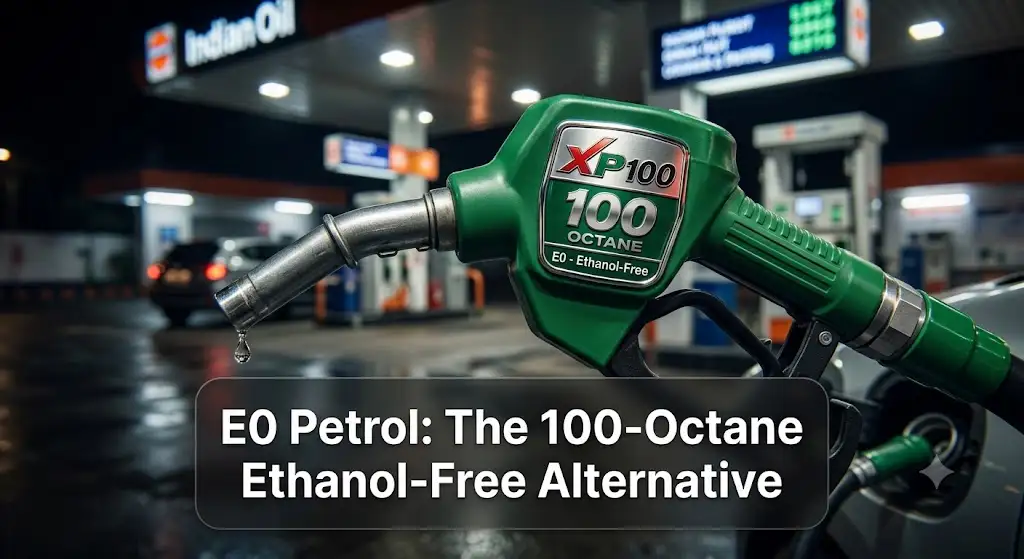
Every standard petrol grade at every pump in India is now E20, blended with 20 percent ethanol. XP95, Speed 95, Shell V-Power, Power 95, Speed 97, all of them contain ethanol. There is no ethanol-free option in the standard or premium segments. But there is one category that remains E0: 100-octane petrol. XP100 from Indian Oil, Speed 100 from Bharat Petroleum, and Power 100 from Hindustan Petroleum are the only grades of petrol available at Indian retail pumps that contain zero percent ethanol. This article explains exactly what they are, where to find them, what they cost, and, critically, who actually needs them and who does not.
Table of Contents
- What E0 Petrol Actually Means
- The Three E0 Options in India
- Why Only 100-Octane Petrol Remains Ethanol-Free
- Where to Find E0 Petrol and What It Costs
- Who Should Use E0 Petrol
- Who Should Not Use E0 Petrol
- The XP95 Myth, and Why It Keeps Spreading
- Sources
What E0 Petrol Actually Means
E0 is simply petrol with zero percent ethanol content. Pure petrol, refined from crude oil, with no alcohol blended in. Before India’s ethanol blending programme began in earnest, all petrol was effectively E0. Today, E0 at a retail pump is the exception, not the rule, and it comes at a significant price premium.
The E in E0, E10, E20, E85 refers to the percentage of ethanol in the fuel blend by volume. E0 is 100 percent petrol. E20 is 80 percent petrol and 20 percent ethanol. The number is not an octane rating, it is an ethanol content label. This distinction matters because many vehicle owners conflate ethanol content with fuel quality, assuming that premium-grade petrol must have less ethanol. That assumption is wrong, and it has led to a widespread misconception that is actively causing problems for older vehicle owners.
E0 petrol has a higher energy content per litre than any ethanol blend. Ethanol contains roughly 34 percent less energy per litre than pure petrol. A litre of E0 delivers more potential energy to your engine than a litre of E20. This is why mileage on E0 is always higher than mileage on E20 in the same vehicle, regardless of the octane rating.
The Three E0 Options in India
XP100, Indian Oil Corporation (IOCL): Launched in December 2020, XP100 was India’s first commercially available 100-octane petrol. It carries a Research Octane Number of 100 and contains zero percent ethanol. IOCL confirmed via a Right to Information reply that XP100 does not have ethanol blending, making it the most authoritatively documented E0 option currently available. XP100 is available at select IOCL pumps across major cities. Current pricing is approximately Rs 167.35 per litre depending on city and state taxes.
Speed 100, Bharat Petroleum (BPCL): BPCL’s 100-octane offering, available at select pumps across eight cities as of early 2026. Zero percent ethanol, 100 RON. Priced at approximately Not Available. The fuel has been independently tested and confirmed ethanol-free. BPCL’s own response on social media confirmed that Speed 97 contains E20, while Speed 100 remains E0, the distinction between the two grades is not just octane, it is ethanol content.
Power 100, Hindustan Petroleum (HPCL): HPCL’s 100-octane, ethanol-free grade. Available at select HPCL outlets. Pricing is approximately Rs 181.16 per litre. Same fuel specification as the other two, 100 RON, E0.
All three are functionally equivalent in their ethanol-free status. The minor differences in formulation, detergent additives, lubricity improvers, may vary by brand but the core specification is identical: 100 RON, zero ethanol.
Why Only 100-Octane Petrol Remains Ethanol-Free
This is the question most vehicle owners do not think to ask, and the answer explains the entire landscape.
Ethanol blending raises the octane rating of petrol. Pure petrol without additives typically has a Research Octane Number of around 88 to 91. Blending in 20 percent ethanol raises that to approximately 95 RON, which is why all standard E20 petrol in India now meets the minimum 95 RON specification under BIS IS 2796.
For premium grades like XP95, Speed 95, Speed 97, and Shell V-Power, the octane boost from ethanol actually helps meet their octane targets without additional refining costs. There is no technical barrier to blending ethanol into these grades, and no commercial incentive for the oil marketing companies to keep them ethanol-free.
For 100-octane petrol, the situation is different. Achieving a genuine 100 RON requires either high-quality base refining, specific performance additives, or both. Blending ethanol at E20 levels into a 100-octane base would raise the RON further, creating a fuel above 100, not a problem in itself, but it would change the product specification and require re-testing and re-certification. More practically, the target market for 100-octane petrol is high-performance vehicles and superbikes whose owners have heightened sensitivity to fuel quality. Introducing ethanol into this grade may likely reduce demand. The oil marketing companies have chosen to keep 100-octane as E0.
This is not a regulatory requirement. There is no BIS standard mandating that 100-octane petrol must be ethanol-free. It is a commercial and technical decision by IOCL, BPCL, and HPCL. In theory, E0 100-octane fuel could be withdrawn or reformulated at any point.
Where to Find E0 Petrol and What It Costs
E0 petrol is available in major cities only. It is not at every pump, it is at select high-traffic outlets and those near premium vehicle dealerships and motorsport venues.
For XP100, IOCL has outlets in Delhi, Gurugram, Noida, Agra, Jaipur, Chandigarh, Ludhiana, Mumbai, Pune, Ahmedabad, Chennai, Bengaluru, Hyderabad, Kolkata, and Bhubaneswar among others. To find the nearest XP100 pump, search the IOCL fuel station locator on the IndianOil website and filter by fuel type.
For Speed 100, BPCL outlets are currently in eight cities. For Power 100, check the HPCL pump locator.
On cost: at approximately Rs 167.35–181.16 per litre versus Rs 100 to 110 for standard E20 petrol in most cities, E0 petrol carries a significant premium. On a 15-litre tank fill, that is Rs 600 to 900 extra per tankful. For daily commuting on a 150cc to 250cc bike doing 40 to 50 kmpl, that translates to approximately Rs 2,500 to 4,000 extra per month in fuel costs. For a 350cc to 500cc bike covering 25 to 35 kmpl, the monthly premium is Rs 1,500 to 2,500.
The E0 Fuel Finder tool on this site is being developed to show verified E0 pump locations near you, initially covering Maharashtra with expansion planned.
Who Should Use E0 Petrol
E0 petrol is appropriate and practically justified for three categories of vehicle and use case.
Long-term vehicle storage: This is the most unambiguous use case for E0. When a vehicle is stored for more than two weeks, during an extended trip, monsoon storage for a vintage bike, or simply a vehicle used only on weekends, E0 petrol eliminates the risk of phase separation. Ethanol in E20 absorbs atmospheric moisture during storage. If enough moisture accumulates, the ethanol-water mixture can separate from the petrol and settle at the bottom of the tank as a layer of dilute alcohol. This layer does not combust cleanly and can cause starting difficulty, rough running, and accelerated corrosion of the fuel tank interior. Filling with E0 before long-term storage prevents this entirely.
Vintage and classic motorcycles with no retrofit available: Pre-BS3 bikes, Royal Enfield bullets from the 1980s and 1990s, Yezdi, Rajdoot, older Jawas, have fuel systems that were designed for pure petrol. Viton hose upgrades may not be available for all models, and carburettor rejetting alone does not address corrosion risk. For these vehicles, E0 petrol on a full-time basis is the most conservative approach to fuel system preservation. The price premium is justified by the cost and difficulty of replacing irreplaceable parts.
High-performance superbikes with 100-RON engine requirements: Some superbikes, primarily imported litre-class motorcycles, have ECUs and compression ratios tuned for 100 RON fuel. Using lower-octane petrol in these engines can cause knock under high loads. XP100, Speed 100, and Power 100 are the correct fuel grade for these vehicles. The ethanol-free aspect is a secondary benefit; the primary reason to use them is the octane requirement.
Who Should Not Use E0 Petrol
This is the section that most people need to read most carefully.
BS4 and BS6 commuter bikes and standard motorcycles: A standard BS4 Bajaj Pulsar, TVS Apache, or Yamaha FZ running on E0 petrol may not experience any performance improvement. These engines are not tuned for 100 RON, their compression ratios and ignition timing are calibrated for 91 to 95 RON fuel. Running 100 RON in a 91-RON engine does not produce more power, better mileage, or reduced wear. The only guaranteed outcome is a significantly higher fuel bill.
The mileage improvement from E0 versus E20 in a standard bike is real, approximately 5 to 8 percent in a BS4 model, because E0 has higher energy density. But at Rs 50 to 60 extra per litre, that mileage recovery costs far more than the mileage lost. The arithmetic does not work for daily use.
BS4 owners seeking to protect their fuel system from ethanol damage: This is the most important misconception to address. Some BS4 owners have concluded that filling with XP100 on every tankful will protect their fuel system from ethanol damage. This logic is correct in its premise, E0 eliminates ethanol exposure. But the solution is disproportionate to the problem. The correct response to ethanol-related fuel system concerns in a BS4 bike is targeted maintenance: replacing nitrile rubber hoses with Viton FKM equivalents, inspecting and replacing carburettor gaskets, and cleaning the fuel system at appropriate intervals. These interventions cost a fraction of the ongoing E0 fuel premium and address the actual failure modes directly.
BS6 Phase 2 vehicles: These are factory E20-compliant. There is no fuel system risk from E20 in a BS6 Phase 2 vehicle. Using E0 petrol provides no benefit beyond the marginal energy density improvement, at a cost that makes no financial sense for daily use.
The XP95 Myth, and Why It Keeps Spreading
A separate article on this site addresses the XP95 misconception in full detail. The short version: XP95 contains 20 percent ethanol. It is E20. It is not ethanol-free, it is not lower-ethanol than standard petrol, and filling with XP95 instead of standard petrol provides no protection against ethanol-related fuel system damage in older vehicles.
The misconception persists because the name “XP95” sounds premium, because it costs more than standard petrol, and because people reasonably assume that a more expensive fuel must be better in every dimension, including ethanol content. None of these assumptions are correct.
IOCL confirmed via Right to Information that XP95 is blended with up to 20 percent ethanol pan India, the same as standard petrol. The only meaningful difference between XP95 and standard E20 petrol is the additive package, detergent and deposit-control additives that may help keep fuel injectors and intake valves cleaner. On ethanol content, they are identical.
If you have been filling your BS4 or older vehicle with XP95 believing it to be ethanol-free, you have been paying a premium for additives while getting the same ethanol exposure as standard petrol. Switch to XP100 if you need genuine E0 petrol for storage or a vintage vehicle. If you are using a standard commuter or mid-range motorcycle daily, the maintenance approach is more cost-effective than any fuel premium.
Sources
- IOCL Right to Information Reply, XP100 Ethanol Content Confirmed, September 2025
- Bureau of Indian Standards, IS 2796 E20 Petrol Specification, RON 95 Minimum
- CarDekho, E20 Petrol Blending Explained: Which Grades Contain Ethanol
- CarToq, Bharat Petroleum Speed 100 Ethanol Fuel Test, March 2026
- IndianOil Corporation, XP100 Product Page
- Bharat Petroleum, Speed Fuels Official Page
- Ministry of Petroleum and Natural Gas, Ethanol Blending Programme