What Is Engine Knock and Why Does Your ECU Retard Timing to Stop It?
-
 Editorial Team
 - 06 Jul, 2026
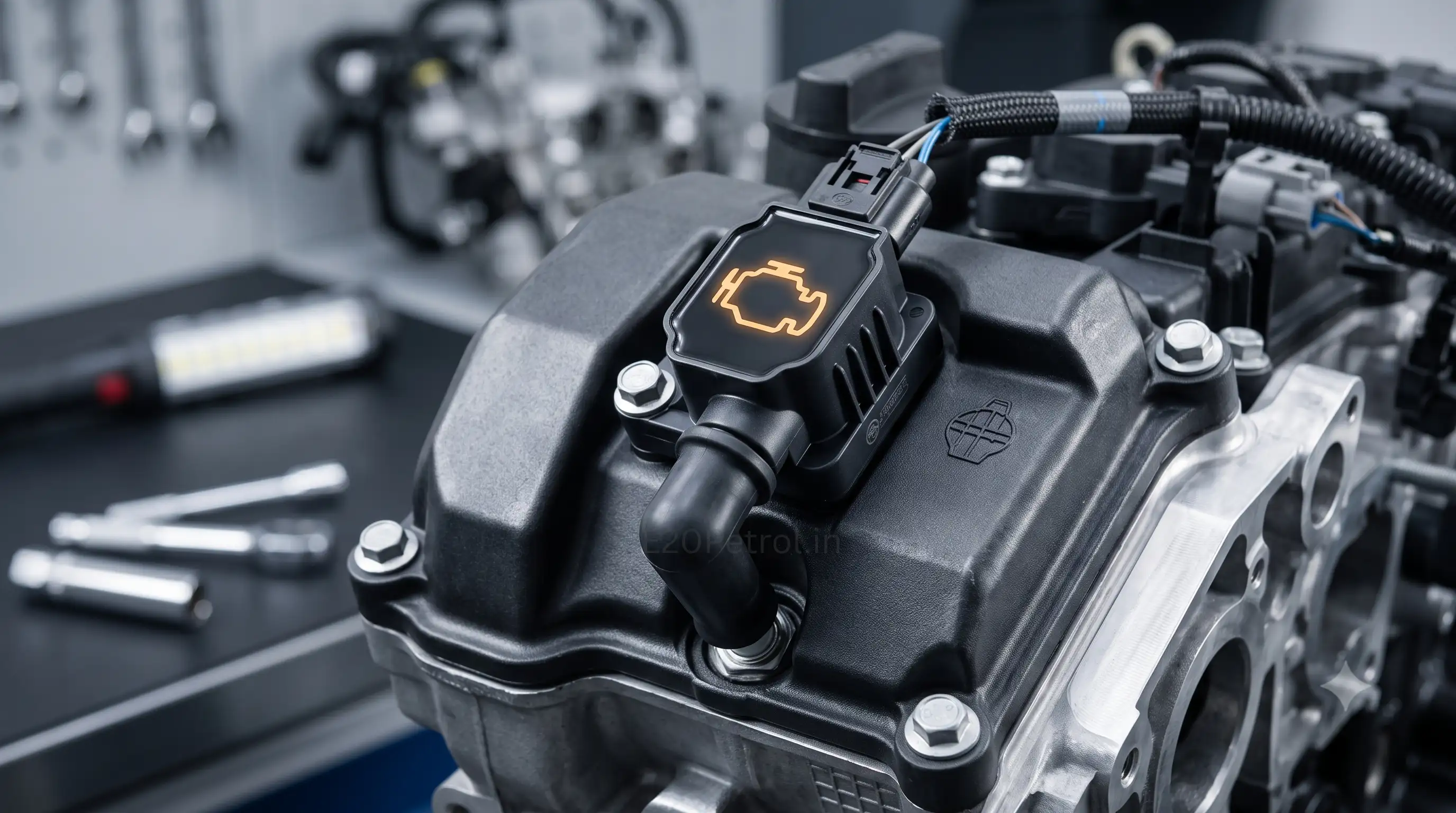
If you have ever asked why fuel grade matters for your engine, the answer comes down to one phenomenon: engine knock. Everything else, RON ratings, ECU calibration, timing advance, the difference between XP95 and XP100, is downstream of this single combustion event.
Understanding what knock is, what it does to an engine, and how the ECU responds to it is the foundation for every fuel decision you will make as an Indian vehicle owner in the E20 era. It explains why a turbocharged Hyundai Creta benefits from XP95 but a Splendor does not. It explains why 100 RON matters for a BMW M-series but is irrelevant for a Honda City. And it explains why running the wrong fuel in a high-compression engine is not just a performance issue, it is a mechanical damage issue.
Table of Contents
- What Engine Knock Actually Is
- What Knock Does to Engine Components
- How the ECU Detects and Responds to Knock
- The Performance Penalty of Timing Retardation
- Why RON Determines How Much Headroom Your ECU Has
- Which Indian Engines Are Most Sensitive to Fuel Grade
- Sources
What Engine Knock Actually Is
In a petrol engine, the four-stroke combustion cycle works like this. The piston descends on the intake stroke, drawing in an air-fuel mixture. It rises on the compression stroke, compressing that mixture to a fraction of its original volume. At the precise moment the piston reaches the top of its travel, the spark plug fires, igniting the mixture in a controlled burn that pushes the piston down on the power stroke. Finally, the exhaust stroke expels the burnt gases.
The critical word in that sequence is “controlled.” The spark plug is supposed to be the trigger. When it fires, a flame front propagates outward from the spark plug electrode, burning through the compressed air-fuel mixture in an orderly expansion. The pressure wave from this combustion pushes the piston down smoothly and consistently, delivering torque to the crankshaft.
Engine knock occurs when the air-fuel mixture auto-ignites before the spark plug fires. The heat and pressure of the compression stroke, combined with the chemistry of the fuel itself, cause portions of the unburned mixture to spontaneously combust ahead of the advancing flame front. This creates multiple, simultaneous pressure waves inside the cylinder that collide with each other. The acoustic result is the characteristic knocking or pinging sound, a sharp, metallic rattle that is most audible under hard acceleration or uphill load. The mechanical result is far more serious than the noise suggests.
The Research Octane Number (RON) is a direct measure of a fuel’s resistance to this auto-ignition. It is determined by running the fuel in a standardised single-cylinder test engine at 600 rpm and comparing its knock resistance against a reference mixture of iso-octane (assigned RON 100, highly knock-resistant) and n-heptane (assigned RON 0, auto-ignites readily). A fuel rated at 95 RON resists knock as effectively as a 95:5 mixture of iso-octane to n-heptane under those test conditions.
What Knock Does to Engine Components
A single knock event is not catastrophic. The engine is designed with tolerances that absorb occasional, mild detonation. The problem is sustained or severe knocking, which exposes internal components to pressure and thermal loads they were never designed to handle.
The piston crown takes the most direct damage. The multiple pressure waves from simultaneous combustion points hammer the piston from multiple directions rather than the single, smooth push of a controlled burn. Over time, this causes pitting and erosion of the piston crown surface, which disrupts the combustion chamber geometry and worsens subsequent combustion events.
Connecting rods transmit the piston’s motion to the crankshaft. Knock-induced pressure spikes create lateral loads on connecting rods that exceed their design specification. Fatigue cracks develop at stress concentration points, particularly around the big-end bearing. These cracks propagate with each knock event until the rod fails, which typically results in catastrophic engine destruction.
Exhaust valves are the third critical vulnerability. Knock elevates in-cylinder temperatures significantly above the designed combustion peak. Exhaust valves, which are already the hottest components in the engine because they open to release hot gases, experience thermal overload under sustained knock. Valve seat recession, where the valve literally pounds its seat into the cylinder head, is the documented long-term result in air-cooled engines running lean on ethanol blends. In severe cases, exhaust valve heads crack or burn through entirely.
How the ECU Detects and Responds to Knock
Modern engines are equipped with knock sensors, piezoelectric microphones bolted to the engine block that convert the acoustic vibrations of combustion into electrical signals. The ECU continuously monitors these signals, filtering for the specific frequency signature of knock (typically 5 to 20 kHz depending on the engine). When the knock sensor registers that signature, the ECU responds within milliseconds.
The primary response is ignition timing retardation. The ECU commands the spark plug to fire later in the compression stroke, the piston is further down its travel before ignition occurs. This reduces the peak cylinder pressure that the unburned end gases experience at the moment of ignition, lowering the probability of auto-ignition. The knock stops.
The ECU then begins a gradual timing advance recovery. Over subsequent engine cycles, typically advancing ignition timing by a fraction of a degree per cycle, it works back toward the optimal timing map. If knock resumes, it retards again. The ECU is continuously hunting for the most advanced ignition timing the fuel will tolerate without knocking, because advanced timing is where maximum power and efficiency live.
This adaptive behaviour is why fuel grade interacts so directly with engine performance. The ECU is not running a fixed timing map, it is running a dynamic map bounded by what the fuel can support.
The Performance Penalty of Timing Retardation
When the ECU retards ignition timing, the spark fires later. The piston has already begun descending from its top position when the flame front expands. The combustion gases push against a piston that is moving away from them at increasing velocity. The mechanical advantage is reduced. The same chemical energy in the fuel delivers less torque to the crankshaft than it would under optimal timing.
The consequences are measurable and interconnected. Power output drops, the engine produces fewer horsepower and newton-metres than its design specification. Fuel efficiency falls, because less work is extracted from each combustion cycle, more fuel must be burned to cover the same distance. And exhaust gas temperatures rise, incomplete extraction of combustion energy means more heat is expelled through the exhaust rather than converted to mechanical work.
For turbocharged engines, the penalty compounds. The turbocharger is driven by exhaust gas energy. When timing retardation reduces combustion efficiency and raises exhaust temperatures, the turbocharger receives a different energy profile than its design assumed. Boost pressure management becomes less predictable. The ECU may also reduce boost pressure targets as a secondary protective measure, further reducing power output.
Team-BHP testing and enthusiast data from Indian turbocharged vehicles document this penalty consistently. A Skoda Slavia 1.5L TSI running standard 91 RON fuel before the E20 mandate, when that fuel was insufficient for the engine’s knock threshold, returned noticeably lower fuel economy figures than the same car on 95 RON. The difference was not in the fuel’s energy content, it was in the timing retardation penalty the ECU imposed to manage knock on the lower-grade fuel.
Why RON Determines How Much Headroom Your ECU Has
The ECU’s ignition timing map has two limits. The lower limit is knock, the ECU will not allow timing so advanced that the fuel auto-ignites. The upper limit is mechanical, the engine’s physical design imposes a maximum advance beyond which no further efficiency gain is possible regardless of fuel quality.
A higher RON fuel pushes the lower limit further from the ECU’s preferred operating point. This gives the ECU more headroom to advance timing toward the mechanical upper limit. In engines specifically designed and calibrated to exploit this headroom, high-compression, turbocharged engines with aggressive factory timing maps, more headroom translates directly to more power, better efficiency, and smoother power delivery.
This is the reason XP95 at 95 RON delivers measurable benefits in a Hyundai Creta 1.4 T-GDI or a KTM Duke 390 that is calibrated for 95 RON operation. The ECU can maintain optimal timing without defensive retardation. The fuel grade matches the engine’s design intent.
XP100 at 100 RON extends this headroom further. For engines that specify 98 RON minimum, Porsche 718, BMW M-series, Audi RS models, Volkswagen EA888 Evo4 variants, running on 95 RON E20 forces the ECU into timing retardation because the fuel’s knock resistance falls below the engine’s calibration threshold. XP100 removes that constraint. The ECU can advance timing to its designed optimum, recover the thermal efficiency that was being lost, and deliver the performance the engine was built to produce.
For naturally aspirated, low-compression engines, a Hero Splendor, a Honda Activa, a Maruti Swift K12N, the ECU’s timing map already reaches its mechanical upper limit on regular petrol. There is no additional headroom to exploit. Providing 95 RON or 100 RON fuel to these engines provides no timing advance benefit. The ECU simply does not need more knock resistance than the fuel already offers. The RON ceiling for these engines sits at or below what standard E20 petrol already provides.
Which Indian Engines Are Most Sensitive to Fuel Grade
Sensitivity to fuel grade is determined by compression ratio, whether the engine is turbocharged, and how aggressively the ECU timing map is calibrated.
High sensitivity, these engines respond measurably to the difference between 91 RON, 95 RON, and 100 RON. Turbocharged GDI engines: Hyundai 1.0 T-GDI and 1.4 T-GDI (Venue, Creta, i20 N Line), Volkswagen 1.0 TSI and 1.5 TSI (Taigun, Virtus, Slavia), Skoda EA888 Evo4 variants (Kodiaq, Octavia), Tata 1.2 Revotron Turbo (Nexon, Altroz Turbo). Performance motorcycles: KTM Duke 390, RC 390, Husqvarna Vitpilen 401, Bajaj Dominar 400, Royal Enfield 650 Twins, Kawasaki Ninja 400.
Moderate sensitivity, these engines respond to the difference between 91 RON and 95 RON but show diminishing returns above 95 RON. Naturally aspirated GDI or multi-point injection engines in the 1.2 to 1.5 litre range with compression ratios above 10:1. Mid-displacement fuel-injected motorcycles in the BS6 Phase 2 range: Yamaha FZ-S V3.1, Honda CB300R, Bajaj Pulsar N250.
Low to no sensitivity, these engines cannot use additional RON beyond what standard E20 provides. Carburetted engines across all displacements. Naturally aspirated low-compression engines: Maruti K10C and K12N, Hyundai 1.2 Kappa, Honda 1.2 i-VTEC in naturally aspirated configuration. Entry-level commuter motorcycles: Hero Splendor, Honda Activa, TVS Jupiter, Bajaj Pulsar 150.
The practical rule is straightforward. If your vehicle’s owner manual specifies a minimum RON, check the fuel specification section, that number is the floor below which the ECU will impose a timing penalty. Matching or exceeding that RON eliminates the penalty. Exceeding it by more than 5 RON in a non-performance engine returns no benefit.
Sources
- IOCL XP95, Official Product Page, Performance Claims
- Octane Rating, Research Octane Number Definition and Test Method
- Speed 97 and High RON Petrol Discussion, ECU Timing and Knock, Team-BHP
- Experiencing 100 RON Fuel in My Skoda Kodiaq, Timing Advance Effects, Team-BHP
- Tried XP100 on My Slavia 1.5L DSG, Team-BHP
- How Much Ethanol Is in Your Petrol?, Autocar India
- Government Mandates 95 Octane E20 Petrol Across India, NDTV Auto